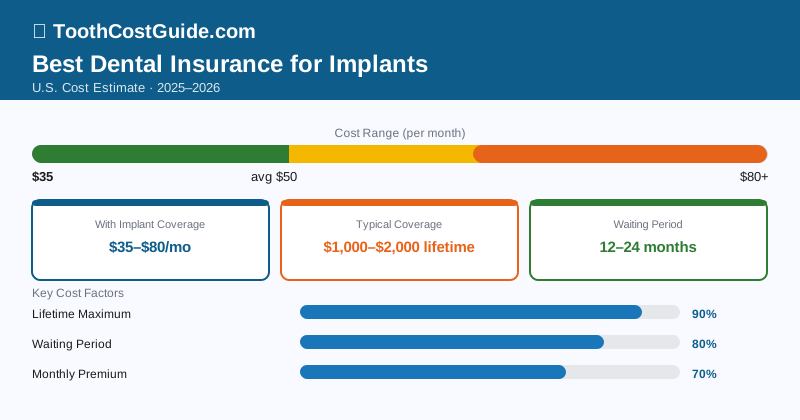
Dental implants cost $3,000–$5,000 per tooth, and the right insurance plan can save you $1,500–$2,500 on each one. The challenge: only 30–40% of dental plans include any implant coverage, and many that do have missing tooth clauses, low annual maximums, or crown-only coverage that limits actual savings. Here’s a ranked comparison of the best dental insurance plans for implants in 2025.
| Plan | Monthly Premium | Covers Implants? | Missing Tooth Clause | Annual Max | Waiting Period |
|---|---|---|---|---|---|
| Spirit Dental Gold | $33–$45 | Yes (full) | No | $3,000 | None |
| Spirit Dental Platinum | $45–$57 | Yes (full) | No | $5,000 | None |
| Ameritas PrimeStar Advance | $40–$55 | Yes (full) | No (most states) | $1,500–$2,000 | 12 months |
| Delta Dental PPO Plus Premier | $40–$60 | Yes (some markets) | Varies by plan | $1,500–$2,000 | 12 months |
| Cigna Dental 1500 Plus | $45–$60 | Yes | Yes (most plans) | $1,500 | 12 months |
| Guardian Direct Diamond | $50–$70 | Yes | Check plan docs | $2,000 | 12 months |
| Humana Complete | $40–$58 | Sometimes | Yes | $1,500–$2,000 | 12 months |
| Standard PPO (most) | $25–$50 | No | Yes or N/A | $1,000–$2,000 | — |
Why Finding Good Implant Coverage Is Hard
Most people assume dental insurance covers implants. Most plans don’t. Here’s why:
Historical classification: Implants were historically classified as “cosmetic” or “experimental” by many insurance companies, and that classification has been slow to change even as implants became the standard of care for tooth replacement (recommended over bridges by the American Dental Association in most cases).
Missing tooth clause: The most common exclusion affecting implant coverage. If you already have a gap in your smile from a tooth lost before your coverage began, many plans won’t cover the implant to fill it — even if the plan technically “covers implants” for teeth lost during coverage. This clause affects the majority of implant candidates who lost teeth years before seeking treatment.
Annual maximum limitations: Even plans that cover implants at 50% are constrained by annual maximums. A $1,500 maximum means the plan pays a maximum of $1,500 per year — which may be consumed entirely by a single implant’s post and abutment, with nothing left for the crown (placed months later).
“Crown only” implant coverage: Some plans cover the “implant crown” (the visible tooth restoration) as a prosthetic but not the implant post (the titanium screw that goes into the jawbone) or the abutment (the connector piece). Since the post and abutment represent the majority of the $3,000–$5,000 total cost, “crown only” coverage may save only $500–$900 rather than the $1,500–$2,500 a full coverage plan would provide.
Before buying any plan advertised as covering implants, ask three specific questions: (1) Does it cover the implant post, abutment, AND crown — or just the crown? (2) Is there a missing tooth clause that would exclude teeth already missing? (3) What is the annual maximum — will it actually cover 50% of a $4,000 implant?
Plan Analysis: Best Options for Implant Coverage
Spirit Dental & Vision — Top Pick for Most Patients
Spirit Gold and Platinum plans are the strongest overall choice for implant coverage:
- Covers implant post, abutment, and crown as major services at 50%
- No missing tooth clause in most states (verify for your state)
- No waiting periods — coverage begins immediately
- Annual maximums of $3,000 (Gold) and $5,000 (Platinum) — high enough to actually cover a significant portion of implant costs
- Available in all 50 states; 130,000+ in-network dentists
Real-world savings example (Spirit Gold):
- Implant total cost: $4,200
- Plan pays 50% = $2,100 (capped at $3,000 annual max, so full $2,100 is paid)
- Annual premiums: $45 x 12 = $540
- Net savings vs. no insurance: $2,100 - $540 = $1,560
Ameritas PrimeStar Advance
Ameritas offers some of the most competitive implant coverage for patients who can wait:
- Covers implants at 50% after a 12-month waiting period
- No missing tooth clause on PrimeStar Advance tier (verify for your state)
- Annual maximum $1,500 in year one, increasing to $2,000+ in subsequent years
- Uses Delta Dental’s provider network in many states — very broad
- Monthly premium: $40–$55 depending on location
Best for: Patients who don’t have an immediate implant need but want coverage for tooth loss that occurs during coverage.
Delta Dental PPO Plus Premier
Delta Dental’s most comprehensive individual plan tier includes implant coverage in many markets:
- Covers implants at 50% after 12-month waiting period
- Missing tooth clause varies — some Delta Dental plans have it, some don’t; check the specific plan for your state
- Annual maximum: $1,500–$2,000
- Massive network: 155,000+ dentists — most dentists in the US participate in Delta Dental
- Monthly premium: $40–$60 depending on state and tier
Best for: Patients whose oral surgeon or dentist is in the Delta Dental network and who have at least 12 months before they need the implant.
Cigna Dental 1500 Plus
Cigna offers implant coverage on its higher-tier plans:
- Covers implants at 50% after 12-month wait
- Missing tooth clause present on most Cigna plans — check before enrolling if you have existing gaps
- Annual maximum: $1,500
- Large network: 90,000+ dentists
- Monthly premium: $45–$60
Best for: Patients with Cigna in-network oral surgeons and sufficient lead time before implant placement.
Guardian Direct Diamond
Guardian offers comprehensive coverage including implants on its premium tier:
- Covers implants at 50%; check plan docs for missing tooth clause
- Annual maximum: $2,000
- Monthly premium: $50–$70
- Available in most states; 110,000+ in-network dentists
What to avoid:
Low-premium PPO plans (under $30/month): Most of these plans explicitly exclude implants or only cover the crown restoration portion.
Dental HMOs: The vast majority of HMO plans do not cover implants. Fixed copay schedules rarely include implant placement.
Plans with $1,000 annual maximums: Even “implant-covered” plans with only a $1,000 annual maximum are nearly useless for implant costs — after preventive care is counted, you may have only $700–$800 left for the implant itself.
Costs & Coverage Details
Spreading implant costs across two policy years:
Implant placement typically involves two stages: surgical placement of the implant post (appointment 1) and crown placement after osseointegration (3–6 months later). By scheduling these in different policy years, you can potentially claim benefits from two annual maximum cycles:
- Year 1 (December): Implant post + abutment, billed as surgical procedure. Insurance pays up to annual max remaining.
- Year 2 (January): Crown placement, billed as prosthetic. Insurance pays up to new year’s annual max.
With a $2,000 annual maximum, this strategy can yield up to $4,000 in total insurance benefits for a single implant over two years — enough to cover 80–100% of the total cost.
Bone graft coverage: Many implant cases require bone grafting before the implant can be placed. Bone grafts cost $300–$3,000. Check whether your plan covers bone grafts — they’re categorized differently than the implant itself and may have different coverage rules.
Multiple implants: For patients needing 4 or more implants (common in seniors), annual maximums are the critical limiting factor. Spirit Platinum’s $5,000 annual max covers about 1.25 implants at 50%; for patients needing all-on-4 or full arch implants, insurance coverage provides only partial help regardless of which plan is selected. Dental schools and financing programs may be more practical for extensive implant cases.
Who Needs Implant-Covering Insurance
Anyone who has received a recommendation for future implants should enroll in implant-covering insurance immediately, even if the procedure is 1–2 years away. Start the waiting period clock now so it’s satisfied when you need the coverage.
People with failing teeth (failing root canals, fractured roots) face probable implants in the near term. No-wait plans like Spirit Dental provide immediate coverage.
Patients with partial dentures who want to convert to implant-supported restorations should seek plans without missing tooth clauses that cover implants.
Adults in their 40s–60s proactively managing long-term dental health should include implant coverage in their dental plan selection — the probability of needing at least one implant over the next 20 years is substantial.
How to Save Money on Implants
Combine insurance with dental school pricing. Some dental schools accept private dental insurance. If your implant-covering plan is accepted at a local dental school (where implant fees are 40–60% lower), your combined savings can be enormous.
Get an exact predetermination. Before treatment begins, have your oral surgeon or dentist submit the full implant treatment plan to your insurance company. The predetermination response tells you exactly what will be covered, whether any exclusions apply, and how much you’ll owe. This prevents surprises.
Ask about multi-implant pricing. When multiple implants are needed, oral surgeons often reduce the per-implant fee. This matters because insurance benefits are limited anyway — a lower base price helps more than marginally higher insurance coverage.
Use an HSA for remaining out-of-pocket. Dental implants are qualified medical expenses. Pay your cost-sharing (the 50% not covered by insurance) with pre-tax HSA dollars to reduce the real cost by your marginal tax rate.
Even the best implant insurance plans won’t cover full-arch implant procedures (All-on-4, All-on-6) comprehensively. These procedures cost $20,000–$50,000 per arch. Insurance annual maximums of $1,500–$5,000 cover only a fraction of full-arch costs. For extensive implant rehabilitation, dental school clinics and third-party financing (CareCredit, etc.) are more practical solutions than insurance.
Spirit Dental Gold or Platinum is the best dental insurance for implant coverage for most patients — no waiting periods, no missing tooth clause, and annual maximums of $3,000–$5,000 that can actually cover a meaningful portion of implant costs. For patients with 12+ months before they need an implant, Ameritas PrimeStar Advance and Delta Dental PPO Plus Premier offer solid coverage at slightly lower premiums.
Bottom Line
Finding dental insurance that truly covers implants requires looking beyond the marketing copy. Spirit Dental Gold/Platinum leads the market with no waiting periods, no missing tooth clause, and high annual maximums. Ameritas and Delta Dental PPO Plus Premier are strong choices for patients with lead time. Always verify the three critical details: full coverage (post + abutment + crown, not just crown), missing tooth clause status, and annual maximum adequacy. For single implants, the right plan saves $1,500–$2,500; for multiple implants, split the procedures across policy years to maximize total benefits.