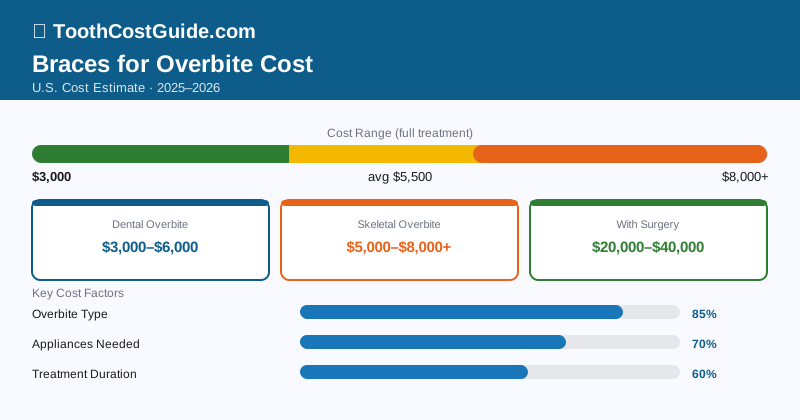
Treating an overbite with braces costs $3,000–$8,000 for comprehensive orthodontic treatment. The exact price depends on the severity of the overbite, whether it’s dental (the teeth themselves) or skeletal (the jaws), and what additional appliances are needed. Mild-to-moderate overbites in children are among the most predictably treatable orthodontic conditions. Severe skeletal overbites in adults may require jaw surgery ($20,000–$40,000) in addition to braces.
| Overbite Treatment Option | Cost Without Insurance |
|---|---|
| Comprehensive braces (dental overbite) | $3,000–$7,500 |
| Invisalign for overbite correction | $3,000–$8,000 |
| Braces + rubber bands (Class II correction) | $3,500–$7,500 |
| Braces + Forsus appliance | $4,000–$7,500 (included) |
| Braces + Herbst appliance | $4,500–$8,000 (included) |
| Orthognathic jaw surgery (severe cases) | $20,000–$40,000 |
| Braces before/after jaw surgery (combined) | $8,000–$15,000 additional |
What Affects Overbite Treatment Cost
Dental vs. skeletal overbite. A dental overbite means the upper teeth protrude due to tooth position — the underlying jaw relationship is acceptable. A skeletal overbite means the upper jaw (maxilla) is positioned too far forward or the lower jaw (mandible) is set too far back. Dental overbites are corrected with braces and rubber bands. Skeletal overbites may require functional appliances in growing patients or jaw surgery in adults.
Age of the patient. Overbite correction is significantly faster and more effective in growing children and teens. Growing patients can use functional appliances (Herbst, Forsus, Twin Block) that take advantage of jaw growth to reposition the jaw relationship — no surgery needed. Adults with fully developed bone must rely on tooth movement alone or, for severe cases, surgery.
Type of appliance required. Standard braces with rubber bands correct mild-to-moderate overbites at no additional cost beyond the braces fee. Functional appliances (Herbst, Forsus) that are cemented to the braces add $500–$1,500 to the total fee when separately quoted, though most orthodontists include them in the comprehensive treatment fee.
Severity. A 3mm overbite corrected over 18 months costs less than a 7mm overbite requiring 28 months of treatment with a functional appliance.
Overbite correction in growing children (ages 10–14) is the most cost-effective approach. Functional appliances can modify jaw growth during this window. Waiting until adulthood means relying entirely on tooth movement, which is less efficient and may not fully correct a skeletal problem without surgery.
Types of Overbite and Treatment Approaches
Mild dental overbite (2–4mm): Common and often treated as part of standard comprehensive braces at no additional cost. Upper front teeth protrude slightly. Treatment with braces and rubber bands over 18–24 months. Invisalign is effective for many mild overbite cases.
Moderate overbite (4–6mm): Requires active bite correction. In teens: functional appliances (Herbst, Forsus springs, rubber bands) during braces. In adults: primarily rubber bands and tooth retraction, taking longer. Invisalign with precision bite ramps can correct moderate overbites.
Severe overbite (6mm+) in growing patients: Functional appliances (Twin Block, Herbst) are highly effective. Treatment often in two phases: Phase 1 with the functional appliance ($1,500–$3,500), followed by Phase 2 comprehensive braces ($2,500–$5,000).
Severe skeletal overbite in adults: When the jaw relationship cannot be corrected through tooth movement alone, orthognathic (jaw) surgery is the only way to achieve full correction. Braces are worn before surgery to align teeth into their correct position within each arch, then surgery repositions the jaw, and post-surgical braces fine-tune the result. Total cost: $20,000–$50,000 depending on the complexity and whether one or both jaws are moved.
Functional Appliances: What Are They?
Herbst appliance: A fixed device that holds the lower jaw forward continuously. Consists of a piston mechanism connecting upper and lower archwires. Cannot be removed — worn 24 hours/day for typically 9–12 months. Very effective for Class II overbite correction in growing teens. Typically included in the comprehensive treatment fee.
Forsus springs: Lightweight spring mechanism attached to the archwires. Simpler than Herbst, slightly less forceful. Worn during the later stages of braces treatment for 6–12 months. Generally included in the comprehensive fee.
Rubber bands (elastics): The simplest form of bite correction. Patient-worn rubber bands connecting upper and lower braces in a Class II pattern, worn 22 hours/day. Cost is included in the standard braces fee. Effectiveness depends on compliance.
Twin Block appliance: A removable Phase 1 appliance used in young children. Upper and lower bite blocks that hold the jaw in a forward position. Used before comprehensive braces. Part of Phase 1 treatment cost ($1,500–$3,500).
Insurance Coverage
Overbite correction as part of comprehensive braces is covered under dental insurance orthodontic benefits on standard terms:
- Lifetime maximum: $1,000–$3,000
- Coverage: 50% up to the maximum
- Age limits: Usually under 18–19 for full coverage
Jaw surgery: If jaw surgery is required, it’s typically covered by medical insurance (not dental insurance) as a medical procedure when functional necessity is documented. Medical insurance may cover 50–80% of the surgery cost after the deductible and out-of-pocket maximum, but pre-authorization is required and the insurance must agree the surgery is medically necessary.
The braces component of combined surgical orthodontic treatment is usually covered by dental insurance up to the orthodontic lifetime maximum. The surgery itself is billed to medical insurance. Getting pre-authorization from both insurers before starting combined surgical orthodontic treatment is essential — billing surprises in these cases can be enormous.
Financing Options
In-office payment plans: Standard 0% interest plans spread over the treatment period. Functional appliance cases (18–30 months) have longer payment plans.
CareCredit: For cases approaching or exceeding the budget, CareCredit’s 24-month promotional 0% APR period allows manageable installments for high-cost cases.
FSA/HSA: Braces and related orthodontic appliances are FSA/HSA eligible. For combined surgical cases, both the orthodontic and surgical portions are eligible medical/dental expenses.
Medical FSA for jaw surgery: Jaw surgery costs are eligible FSA and HSA expenses. Using a combination of dental FSA (for braces) and medical FSA (for surgery) maximizes pre-tax coverage of combined treatment.
How to Save on Overbite Treatment
Treat early in children. Phase 1 functional appliance treatment at ages 9–12 is less expensive than waiting for adult jaw surgery. The AAO-recommended age-7 evaluation exists precisely to catch these cases early.
Compare orthodontists and ask about functional appliances. Some orthodontists prefer rubber bands (least expensive, compliance-dependent) while others prefer Herbst appliances (more reliable). Understand what’s included in your quoted fee.
Consider dental schools for combined surgical cases. For cases requiring jaw surgery, academic medical centers with oral surgery residency programs and orthodontic residency programs can coordinate combined treatment at significantly lower cost.
Verify medical insurance for surgery. If jaw surgery is required, work with an oral and maxillofacial surgeon who is in-network with your medical insurance plan. Out-of-network surgery for a major orthognathic case can cost $5,000–$15,000 more than in-network.
Bottom Line
Overbite correction costs $3,000–$8,000 with braces or Invisalign for most dental and moderate skeletal cases. Growing patients benefit enormously from early treatment with functional appliances that take advantage of jaw development. Severe adult skeletal overbites requiring jaw surgery involve combined orthodontic and surgical costs of $20,000–$50,000, partially offset by medical insurance coverage of the surgical component. Start early, verify insurance for both dental and medical components, and get multiple consultations for complex cases.
Overbite correction is one of the most predictable orthodontic treatments when caught in growing children. Early Phase 1 treatment with functional appliances can prevent the need for jaw surgery entirely. Adults with skeletal overbites face higher costs and more limited options — making early childhood evaluation one of the most cost-effective dental decisions a parent can make.