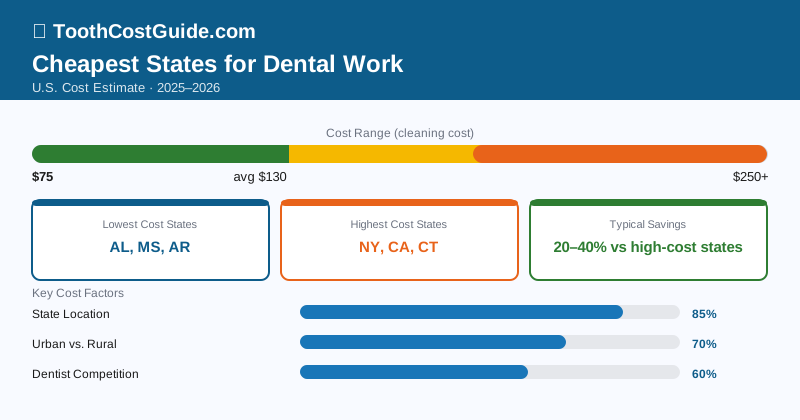
Dental prices in the US vary by up to 60% depending on the state — a crown that costs $1,800 in Connecticut or California may cost just $700–$900 in Mississippi, Alabama, or Arkansas. For patients willing to travel, or those choosing where to get major dental work done, understanding state-level pricing differences can mean savings of $500–$5,000 on large treatment plans.
| State | Crown (avg) | Root Canal (avg) | Implant (avg) | Relative Cost Index |
|---|---|---|---|---|
| Mississippi | $750–$900 | $600–$800 | $2,800–$3,500 | Lowest |
| Alabama | $750–$950 | $650–$850 | $2,900–$3,600 | Very Low |
| Arkansas | $800–$950 | $650–$850 | $3,000–$3,700 | Very Low |
| Oklahoma | $800–$1,000 | $700–$900 | $3,000–$3,800 | Low |
| Tennessee | $850–$1,050 | $700–$900 | $3,100–$3,900 | Low |
| Kentucky | $850–$1,050 | $700–$950 | $3,100–$4,000 | Low |
| West Virginia | $800–$1,000 | $700–$900 | $3,000–$3,800 | Low |
| Texas (rural) | $850–$1,100 | $750–$950 | $3,200–$4,200 | Medium-Low |
| Ohio | $900–$1,150 | $800–$1,000 | $3,400–$4,200 | Medium |
| Florida | $1,000–$1,400 | $850–$1,150 | $3,600–$4,800 | Medium-High |
| New York City | $1,400–$2,200 | $1,100–$1,700 | $4,500–$6,000 | High |
| California (major cities) | $1,400–$2,000 | $1,100–$1,600 | $4,500–$6,000 | High |
| Connecticut | $1,400–$2,100 | $1,100–$1,700 | $4,500–$6,200 | Highest |
| Massachusetts | $1,350–$2,000 | $1,050–$1,650 | $4,400–$5,800 | High |
How It Works
Dental fees are set by individual practices and reflect local economic conditions. The primary drivers of price variation by state are:
Cost of living: Dentists in high-cost urban areas pay higher rent, higher staff salaries, and higher malpractice insurance — and pass those costs to patients. A dental office in San Francisco’s financial district operates at 3–4x the overhead of a practice in rural Mississippi.
UCR (Usual, Customary, and Reasonable) rates: Insurance companies set reimbursement rates by zip code using UCR data. These rates create a de facto “standard price” in each market. Dentists in high-UCR markets charge more because insurance pays more.
Urban vs. rural differences: Within any given state, rural dentists charge 15–30% less than their urban counterparts. Texas rural vs. Dallas or Houston pricing mirrors this pattern clearly.
Competition density: States with high dental school enrollment (NY, CA, IL) have more dentists per capita, which increases competition and moderates prices in some markets.
Costs & Savings Details
Dental tourism within the US: Patients from high-cost states sometimes travel to lower-cost states for major dental work. A patient in California needing an implant ($5,000+ locally) could fly to Tennessee or Kentucky, have the implant placed at $3,200, stay one night, and repeat for the crown placement — spending ~$3,800 total including travel vs. $5,000+ at home.
Real savings for common treatment plans:
A full treatment plan (2 implants + 3 crowns + root canal):
- Connecticut/California: $14,000–$18,000
- Tennessee/Kentucky: $8,500–$11,000
- Savings: $3,000–$7,000
Best value states for dental tourism within the US:
- Tennessee: Low costs, strong dental school presence (Meharry, UT Health), Nashville accessible from much of the Southeast
- Kentucky: Very competitive pricing, accessible from Midwest
- Oklahoma: Low dental costs, minimal congestion, affordable hotels
- Ohio (particularly Dayton, Columbus suburbs): Mid-range costs, good dental school presence (Ohio State)
Eligibility / Who Qualifies
There are no eligibility requirements for dental tourism within the US — any American can choose where to receive dental care. Considerations that determine whether in-state dental tourism is practical:
- Is the cost difference large enough to justify travel expenses?
- Can you schedule multiple visits efficiently (implants require 2–3 trips)?
- Do you have a local dentist who can handle urgent issues or post-treatment complications?
As a rough guide: in-state dental tourism makes financial sense when the cost difference for the full treatment plan exceeds $1,000–$1,500 (after travel costs).
Pros and Cons
Pros
- Genuine, significant savings on major procedures
- All US states are subject to the same dental licensing and standard-of-care requirements
- No language barrier or international travel concerns
- English-language records, x-rays, and follow-up care is seamless
- Can combine with visiting family or other travel
Cons
- Multi-visit procedures (implants) require multiple trips
- Establishing a new patient relationship takes time and a full intake process
- Local dental emergency management may require you to find a new dentist at home
- Travel costs can eat into savings for shorter procedures
When seeking dental care in a lower-cost state, verify the dentist’s license through that state’s dental board website before scheduling. Look for reviews from patients who traveled for care. Choosing a lower-cost state doesn’t mean choosing lower quality — but you should do your due diligence just as you would when choosing any new dentist.
Step-by-Step Guide
Get a comprehensive treatment plan from your local dentist: You need a written, itemized plan with CDT procedure codes to comparison-shop effectively.
Use Fair Health Consumer: Visit fairhealthconsumer.org and check the “90th percentile” cost for your specific procedure codes across different zip codes. Compare your home zip code to lower-cost regions.
Identify target states or cities: Based on your fair-health comparison, identify 2–3 regions where costs are significantly lower. Focus on areas that are accessible (within 2–4 hours flight or drive) and have multiple quality dental practices.
Search for dentists in target area: Use Zocdoc, Google reviews, and state dental association directories to find well-reviewed dentists in your target area. Look for offices that explicitly welcome patients traveling for care.
Contact offices and request quotes: Call 2–3 offices, explain that you’re traveling for care, and ask for a fee estimate for your specific procedure codes. Offices familiar with dental tourists will be prepared for this conversation.
Calculate full cost comparison: Quote + flights or driving cost + hotel (if needed) = total cost. Compare to home dentist price. If savings exceed $1,000–$1,500, traveling may make financial sense.
Coordinate care: Establish a timeline that minimizes trips (e.g., for implants, can the workup CT scan be done at home with results sent ahead?). Ask the traveling dentist about their protocol for follow-up complications.
Even without traveling, knowing the price range in lower-cost states is valuable negotiating information. When your dentist quotes $1,600 for a crown, you can truthfully say: “I’ve looked at pricing and seen fees of $900–$1,100 for this same procedure in neighboring states. Is there any flexibility here?” Many dentists will meet you partway rather than lose you to a lower-cost area.
Bottom Line
State-level dental price variation is real and substantial — up to 60% between the cheapest and most expensive markets. For patients facing major treatment (multiple implants, full mouth reconstruction, or several crowns), the savings from traveling to a lower-cost state can easily offset travel costs. Tennessee, Kentucky, Arkansas, and Oklahoma consistently offer the best combination of low fees and accessible quality dentistry. Use Fair Health Consumer to validate the specific price difference for your procedures before committing to the trip.