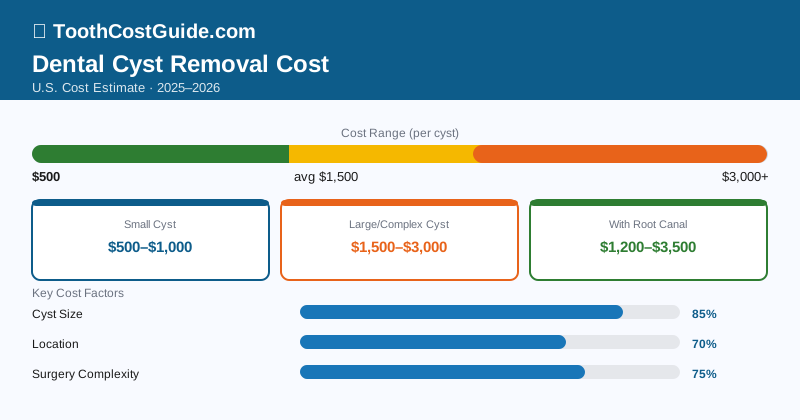
Dental cyst removal costs $500–$1,000 for small, simple cysts, and $1,500–$3,000+ for larger cysts requiring bone surgery, grafting, or specialist care. Most dental cysts are discovered incidentally on X-rays rather than causing pain — but they require treatment because they can destroy surrounding bone, displace teeth, and rarely (odontogenic keratocysts) recur or transform into more serious conditions.
| Cyst Type & Procedure | Cost (No Insurance) |
|---|---|
| Panoramic X-ray or CBCT (diagnosis) | $150–$500 |
| Periapical cyst (apicoectomy) | $600–$1,500 |
| Dentigerous cyst removal | $800–$2,000 |
| Odontogenic keratocyst (OKC) removal | $1,500–$4,000 |
| Marsupializtion (large cysts) | $800–$2,000 |
| Bone graft (after cyst removal) | $300–$1,500 |
| Biopsy (pathology fee) | $150–$400 |
| General anesthesia (hospital) | $1,000–$3,000 additional |
What Affects the Cost
Type of cyst. There are several types of dental (odontogenic) cysts:
- Periapical (radicular) cyst: The most common type. Forms at the root tip of a dead tooth. Treated with apicoectomy or tooth extraction.
- Dentigerous cyst: Forms around the crown of an unerupted or impacted tooth, most commonly wisdom teeth. Requires extraction of the associated tooth plus cyst removal.
- Odontogenic keratocyst (OKC): More aggressive; higher recurrence rate. Requires more extensive surgery and careful follow-up.
- Nasopalatine duct cyst: Occurs in the midline of the palate. Usually treated surgically.
Size of the cyst. Small cysts (under 1 cm) confined to the bone near one tooth are straightforward and less expensive to remove. Large cysts spanning multiple teeth or extensive regions of the jaw may require marsupialization (surgical decompression to allow gradual shrinkage over months before definitive removal) — adding complexity and cost.
Whether biopsy is needed. All dental cyst tissue should be sent for histopathologic analysis to confirm the diagnosis. The biopsy/pathology fee ($150–$400) is separate from the surgical fee.
Provider. General dentists perform apicoectomies and simple cyst removal. Oral and maxillofacial surgeons handle larger, more complex lesions. Endodontists may perform apicoectomies. Each specialty has different fee structures.
Whether bone grafting is needed. After removing a large cyst, the resulting cavity may require bone graft material to promote healing and prevent bone collapse. This adds $300–$1,500 to the total cost.
Treatment Options & Costs
Apicoectomy ($600–$1,500): A minor oral surgery procedure performed when a periapical cyst cannot be managed by root canal treatment alone. The tip of the tooth’s root is removed along with the surrounding cyst tissue through a small incision in the gum. Performed under local anesthesia in the dental office. Most cases heal well and the tooth is preserved.
Enucleation — cyst removal ($800–$2,000): The cyst is completely removed (shelled out) from the bone. Standard treatment for dentigerous cysts and most other odontogenic cysts. Performed under local anesthesia or IV sedation by an oral surgeon. Tissue sent to pathology for confirmation.
Marsupialization ($800–$2,000 initially): For very large cysts, a window is cut into the cyst wall and sutured open to allow the cyst to decompress gradually over 6–12 months. This reduces the cyst to a manageable size before definitive enucleation. Two-stage approach adds time and cost but reduces the risk of damaging adjacent teeth and nerves during removal of a large lesion.
Enucleation with Carnoy’s solution (OKC): Odontogenic keratocysts are lined by a specific epithelium with high recurrence potential. After surgical removal, Carnoy’s solution (a chemical fixative) is applied to the bone cavity to destroy any remaining cyst cells and reduce recurrence. Adds complexity and time. OKC has a 25–60% recurrence rate without additional treatment.
With vs. Without Insurance
Dental cyst removal is generally covered under oral surgery benefits:
- Apicoectomy: Covered at 50–80% by most PPO plans under major restorative/oral surgery; ADA code D3410–D3430
- Cyst removal (enucleation): Covered at 50–80% under major oral surgery (ADA D7450–D7461)
- Biopsy: Covered at 50–80% under oral surgery
- Bone grafting: Variable; some plans cover at 50–70%, others exclude
Medical insurance may cover cyst surgery performed in a hospital setting or under general anesthesia, particularly for large lesions requiring more extensive procedures.
Annual maximum impact: A $2,000 cyst removal procedure covered at 60% still leaves $800 out of pocket — and may exhaust most of your annual dental maximum, leaving little for other needed care.
Out-of-pocket with insurance example:
- Apicoectomy + biopsy: $1,200
- Insurance pays 60%: $720
- Patient pays: $480 (plus any deductible)
What To Do
- Don’t ignore it. Dental cysts discovered on X-rays require evaluation even if painless. Most cysts grow slowly but continuously and will cause damage if untreated.
- Get a CBCT scan for any significant cyst — this 3D X-ray gives the surgeon a precise map of the cyst relative to teeth, nerves, and sinus. Costs $250–$500 but is essential for surgical planning.
- See an oral surgeon for evaluation for cysts larger than 1 cm or those involving multiple teeth.
- Ask about biopsy. All removed cyst tissue should be examined pathologically — confirm this will be done.
- Understand follow-up requirements. Some cysts (especially OKCs) require long-term radiographic monitoring to detect recurrence — factor in 1–2 X-ray visits per year for 5+ years.
- Ask about marsupialization for very large cysts — it adds a step but may preserve teeth that would otherwise be lost during immediate enucleation.
How to Save Money
University oral surgery clinics. Dental school oral surgery programs remove cysts at 40–60% below private practice rates. Residents are closely supervised by faculty oral surgeons.
Understand your insurance codes. Know the ADA procedure codes for your planned treatment (D3410 for apicoectomy, D7450 for cyst removal) and verify coverage percentages with your insurer before scheduling. Insurance often reimburses cyst removal differently based on location and cyst type.
Get the biopsy. It’s tempting to skip the pathology fee, but the biopsy is medically essential — different cyst types have very different recurrence and transformation risks. Don’t compromise on this to save $200.
Split treatment if cost is prohibitive. For cysts requiring both extraction and cyst removal, these can sometimes be staged — though ideally they’re done in one surgical session to minimize anesthesia and recovery.
A suspected dental cyst should always be biopsied (tissue examined pathologically). Rarely, cysts can be associated with odontogenic tumors or, in the case of odontogenic keratocysts, with Gorlin-Goltz syndrome (basal cell nevus syndrome) — a genetic condition requiring medical follow-up. Do not skip pathologic examination to save money.
Bottom Line
Dental cyst removal costs $500–$3,000 depending on the type, size, and complexity. With insurance covering 50–80%, most patients pay $400–$1,500 out of pocket. All removed cyst tissue must be biopsied. University oral surgery clinics provide the most affordable option without compromising care. Don’t ignore a cyst discovered on X-ray — slow-growing cysts cause serious bone damage over time if untreated.