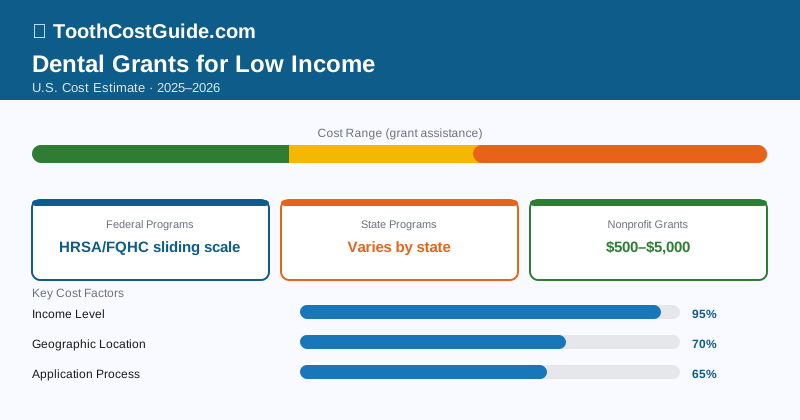
Dental grants for low-income Americans can cover hundreds or even thousands of dollars in dental costs — but unlike loans or financing, grants don’t have to be repaid. Federal programs, state health departments, and nonprofit organizations collectively fund dental grant programs reaching millions of Americans annually. The challenge is knowing where to apply and meeting the specific eligibility requirements.
| Grant/Program Type | Funding Source | Coverage Amount | Who Qualifies |
|---|---|---|---|
| HRSA Health Center grants | Federal (HRSA) | Sliding scale, near-zero cost | Income up to 200% FPL |
| Head Start dental | Federal (ACF) | Free preventive + restorative | Children 0–5 in Head Start |
| CHIP dental benefits | Federal/state | Free or low-cost comprehensive | Children at 200–300% FPL |
| State dental grant programs | State health dept | Varies ($200–$2,000) | Low-income adults, varies by state |
| Dental Lifeline Network DDS | Nonprofit | Comprehensive care free | Elderly, disabled, medically fragile |
| America’s ToothFairy grants | Nonprofit | Reduced fees at clinics | Uninsured children |
| United Way dental assistance | Nonprofit/local | Varies | Low-income families |
| Foundation for Health Coverage | Nonprofit | Application-based | Chronically uninsured |
How It Works
Dental grants operate through three main funding streams:
Federal grants to health centers: The Health Resources & Services Administration (HRSA) funds Federally Qualified Health Centers (FQHCs) through grants. These centers must offer services on a sliding-fee scale, meaning patients at or below 100% of the federal poverty level often pay $0. This is the most widely available form of “grant-funded” dental care — it just reaches you as reduced or zero-cost services rather than a check made out to you.
Direct grants from state programs: Some states (California, New York, Oregon, Washington) operate dental grant programs that either fund safety-net clinics or provide direct patient assistance. These vary significantly by state.
Nonprofit grants: Organizations like Dental Lifeline Network, America’s ToothFairy, and the Smiles for Everyone Foundation provide grants to dental clinics or directly to patients in the form of free or heavily subsidized care.
Costs & Savings Details
FQHC sliding-scale fee savings: A patient at 100% of the federal poverty level (~$15,650 for a single person in 2025) may pay:
- Dental exam: $0–$5 (vs. $75–$150 at a private dentist)
- Cleaning: $0–$10 (vs. $100–$200)
- Filling: $0–$20 (vs. $150–$300)
- Extraction: $0–$25 (vs. $150–$350)
- Root canal: $0–$50 (vs. $800–$1,500)
Head Start dental: Enrolled children in federal Head Start programs receive dental screening, fluoride varnish, and referrals at no cost. Some Head Start programs provide on-site dental treatment — completely free for enrolled families.
State dental assistance programs: Examples:
- California: Denti-Cal covers comprehensive dental for Medicaid enrollees; state-funded clinics provide additional services
- New York: State funds safety-net dental programs supplementing Medicaid
- Oregon: Oregon Health Plan includes comprehensive dental; state dental grants supplement FQHC capacity
- Illinois: Dental/oral health grants to safety-net providers reduce patient fees
Dental Lifeline Network: Provides comprehensive, multi-visit free care worth an average of $2,500–$5,000 per qualifying patient.
Eligibility / Who Qualifies
HRSA-funded FQHCs (sliding-scale grants):
- Anyone, regardless of insurance status, can access FQHC care
- Sliding-fee scale requires income documentation for reduced fees
- 100% FPL or below: typically $0 cost
- 101–200% FPL: nominal fees based on sliding scale
- No citizenship requirement for many FQHCs
Head Start:
- Children ages 0–5 whose family income is at or below the federal poverty level
- Children in foster care or receiving public assistance automatically qualify
CHIP dental:
- Children under 19 whose families earn too much for Medicaid but cannot afford private insurance
- Income limits: 200–300% FPL in most states (varies)
Dental Lifeline Network DDS:
- Age 65+, OR permanently disabled, OR medically fragile, AND
- Cannot afford dental care (income and asset documentation required)
State programs: Highly variable. Check your state’s health department website under “oral health” or “dental assistance program.”
Pros and Cons
Pros
- No repayment required — grants are not loans
- FQHC sliding-scale fees are available nationwide
- No credit check or credit score impact
- Some programs cover comprehensive care, not just emergencies
Cons
- Waitlists are common for popular programs (especially Dental Lifeline Network)
- Many programs have strict income or demographic criteria
- Grant funding can be limited — programs may have capacity constraints
- Not all procedures are covered under grant-funded programs
Beware of websites claiming to offer “dental grants” in exchange for a fee or personal financial information. Legitimate grant programs are free to apply to. If you’re asked to pay to “apply” for a dental grant, it’s a scam.
Step-by-Step Guide
Find your nearest FQHC: Visit findahealthcenter.hrsa.gov and enter your zip code. Call the dental department to confirm services, current availability, and to ask about the sliding-fee discount application process.
Apply for CHIP or Medicaid for children: Visit healthcare.gov or your state’s Medicaid portal. Children under 19 in families at 200–300% FPL typically qualify for CHIP dental coverage at low or no cost.
Locate Head Start programs: If you have children ages 0–5 with income at or below the federal poverty level, contact your local Head Start agency (search headstart.gov for your region). Head Start dental is part of the comprehensive health component.
Apply to Dental Lifeline Network: If you’re elderly (65+) or permanently disabled and cannot afford care, visit dentallifeline.org and click “Get Dental Care.” Complete the state affiliate application with income and medical documentation.
Contact your state health department: Search “[State] Department of Health oral health grants” or “[State] dental assistance program low income.” State programs are updated frequently — check directly for current opportunities.
Dial 2-1-1: The United Way’s 2-1-1 helpline connects you with local dental assistance programs including grants, vouchers, and reduced-cost clinics. Call or text 211, or visit 211.org.
Ask your local dental school: Dental and dental hygiene schools often have grant-funded community outreach programs providing free or near-free care. Search “[City] dental school community clinic” for programs near you.
If you are at or below 200% of the federal poverty level and live near an FQHC, you may pay $0–$20 for dental procedures that would cost $500–$2,000 at a private dentist. The FQHC sliding-fee benefit is not technically called a “grant” but is funded by federal grants to the health center — it’s the most broadly accessible free dental care program in the country. Start at findahealthcenter.hrsa.gov.
Bottom Line
“Dental grants for low-income patients” is really a cluster of different programs under different names — FQHCs, state health programs, nonprofit care, and Head Start all channel grant money into free or near-free dental care for qualifying patients. The most universally accessible path is an FQHC, available in every state and serving patients regardless of insurance status on a sliding-fee scale. For elderly or disabled adults, the Dental Lifeline Network’s DDS program provides comprehensive free care and is dramatically underutilized. Start with a 2-1-1 call to identify what’s available in your specific community.