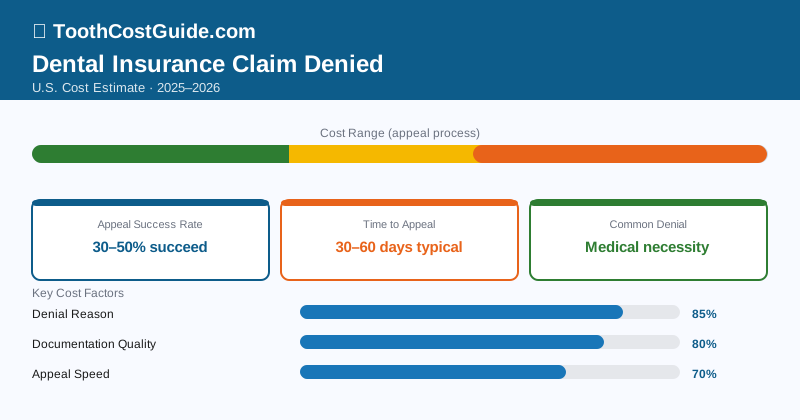
Approximately 1 in 7 dental insurance claims is denied on initial submission — but roughly 40–60% of appealed denials are overturned in favor of the patient. A denial doesn’t mean the final answer is no. It means the insurer wants more information, found a technical issue, or is applying a coverage rule that can be contested. Knowing why claims get denied and how to appeal effectively can recover hundreds to thousands of dollars per year.
| Denial Reason | Frequency | Fix |
|---|---|---|
| Not medically necessary | ~25% of major work denials | Submit clinical documentation, X-rays, dentist letter |
| Waiting period not met | ~20% | Check enrollment date; appeal if prior coverage existed |
| Annual maximum reached | ~15% | Not appealable; use end-of-year or discount plan |
| Missing tooth clause | ~10% | Appeal if tooth was lost during coverage |
| Procedure not covered (excluded) | ~15% | Check plan documents; appeal if classification is wrong |
| Missing/incorrect claim information | ~10% | Correct and resubmit |
| Duplicate claim | ~5% | Submit corrected claim with dates |
| Out-of-network, no OON benefit | ~5% | Switch to in-network; limited appeal options |
Why Dental Claims Get Denied
Understanding the reason for a denial is the first step to fixing it. The Explanation of Benefits (EOB) you receive after a claim is processed includes “remark codes” or denial reason descriptions. Here are the most common causes:
1. Not medically necessary (NMN): The most common reason for denial of major services like crowns. The insurer’s clinical reviewer determined that the procedure wasn’t medically necessary based on the submitted information. This doesn’t mean the dentist was wrong — it means the insurer didn’t have enough clinical evidence to approve it.
What to do: Request that your dentist provide supporting documentation including:
- Current X-rays showing the tooth’s condition
- Clinical notes describing why a crown (vs. a filling) was necessary
- Photos of the tooth if available
- Dentist’s written explanation of why less expensive treatment alternatives were ruled out
2. Waiting period not met: The claim was submitted before the plan’s waiting period for that service category ended. Common when patients recently enrolled or switched plans.
What to do: If you had prior continuous dental coverage (no gap over 30–63 days), request a waiver. Submit a Certificate of Prior Coverage from your previous insurer and a letter requesting the waiting period be waived. Most insurers allow this.
3. Annual maximum exceeded: The insurer has paid its maximum for the year. This is not really an error — it’s a plan limitation.
Limited appeal options: If the maximum was incorrectly calculated (e.g., a prior claim was included that shouldn’t count toward your maximum), submit an appeal with claim records. Otherwise, plan remaining treatment for the new policy year.
4. Missing tooth clause: The plan won’t pay for replacement (implant, bridge) of a tooth that was already missing when coverage started.
What to do: If you believe the tooth was lost during your coverage period (after the coverage start date), submit documentation of when the tooth was lost — extraction records, hospital records, prior dental records showing the tooth was present at enrollment.
5. Procedure classified incorrectly (code disputes): The procedure was billed under a code the insurer doesn’t cover, or the insurer reclassified it to a different (non-covered or lower-benefit) procedure.
What to do: Have your dentist review the claim and confirm the correct CDT code was used. If the insurer applied “least expensive alternative treatment” (LEAT) and is paying the amalgam rate for a composite filling, this is allowable under most plans but check your specific plan language.
6. Administrative/technical errors: Wrong date of birth, incorrect member ID, missing tooth number, dentist’s NPI not matching — these are bureaucratic errors that are easy to fix with a corrected claim.
What to do: Call your insurer to identify the specific error, have your dental office correct and resubmit the claim, and follow up to confirm the corrected claim was received.
7. Pre-authorization required but not obtained: Some procedures (crowns, implants, dentures) require the dentist to get advance approval before performing the service. If the work was done without prior authorization where required, the claim may be denied.
What to do: Ask your dentist if a retroactive authorization is possible. Some insurers allow this within a limited time window. Going forward, always verify pre-authorization requirements before major procedures.
8. Service frequency limit exceeded: Many dental plans limit certain services — for example, one cleaning every 6 months, or one set of bitewing X-rays per year. If you had two cleanings within the same 6-month period, the second may be denied.
What to do: Timing adjustments for future appointments. For the current denial, if there was a clinical reason for more frequent care (active periodontal disease requiring 3-month maintenance), ask your dentist to submit documentation of the clinical necessity.
“Not medically necessary” denials are the most common and the most frequently overturned on appeal. They don’t mean your dentist was wrong — they mean the insurer didn’t have the clinical documentation they needed to approve the claim. Providing X-rays, clinical notes, and a dentist letter resolves the majority of NMN denials.
The Step-by-Step Appeal Process
Step 1: Understand the denial. Read your Explanation of Benefits (EOB) carefully. Identify the denial reason code. If unclear, call your insurer’s member services number (on the back of your ID card) and ask for a plain-language explanation of why the claim was denied.
Step 2: Determine if the denial is correctable.
- Technical/administrative error (wrong ID, missing code)? → Simple resubmission, often resolved in days.
- Not medically necessary? → Requires clinical documentation appeal.
- Waiting period? → Prior coverage documentation.
- Annual maximum? → Limited options; focus on year-end planning.
- Excluded service? → Review plan documents; may require formal appeal.
Step 3: Gather your documentation. Depending on the denial type, collect:
- Your denial letter or EOB with the denial code
- Your insurance plan documents (Summary of Benefits)
- Your dental records: X-rays, clinical notes, treatment plan
- A written letter from your dentist explaining clinical necessity
- Certificate of Prior Coverage (if disputing a waiting period)
- Any prior correspondence with the insurer
Step 4: Write a formal appeal letter. Address the letter to the insurer’s Appeals Department (address on the denial notice or member portal). Include:
- Your name, member ID, and plan number
- The claim number and date of service being appealed
- A clear statement: “I am appealing the denial of [procedure] for [clinical reason]”
- A brief explanation of why coverage should be granted
- A list of all attached documents
Step 5: Submit the appeal within the deadline. Most plans require appeals to be filed within 90–180 days of the denial. Check your specific plan — missing the deadline forfeits your appeal right. Submit by certified mail or through the insurer’s secure member portal for documentation of receipt.
Step 6: Follow up. Insurers typically have 30–60 days to respond to appeals. Call member services every 2 weeks to check status. Keep a log of every call: date, representative name, and what was discussed.
Step 7: If the appeal is denied — escalate.
- External appeal: Most states require insurers to offer an external appeal review by an independent medical reviewer. Request this if your internal appeal is denied.
- State Insurance Commissioner: File a complaint if you believe the denial was improper. State insurance regulators investigate complaints and can compel insurers to reconsider.
- State-specific protections: Some states have additional dental claim protections. Contact your state’s department of insurance.
- Your employer’s HR department: If you have employer-sponsored dental insurance, HR may be able to intervene on your behalf with the insurer.
How to Avoid Denials in the First Place
Get pre-authorization before major work. Submitting the treatment plan to the insurer before the procedure is performed allows them to flag any coverage issues in advance — before you’ve committed to the procedure. A pre-authorization denial is much easier to address than a post-treatment denial.
Have your dentist document clinical necessity. For crowns, bridges, and other major work, ensure the clinical record thoroughly documents why the procedure was necessary (tooth fracture, structural compromise, large existing restoration, etc.) before submitting the claim. Insurers reviewing claims look for clinical justification.
Verify your benefits before every appointment. Know which procedures require pre-authorization, what waiting period status you’re in, and how much annual maximum you have remaining. Your insurer’s member portal shows all of this in real time.
Use in-network dentists consistently. Out-of-network claims involve additional complexity — different fee schedules, balance billing, and sometimes different coverage levels. Staying in-network eliminates most technical denial issues.
Check claim submissions promptly. Review your EOB within a few days of your dental visit. If there’s an error, catching it early gives you maximum time to correct and resubmit before deadlines expire.
Some dental practices submit claims using broad procedure codes and then code more specifically if the insurer questions it. While not fraudulent, this can lead to initial denials that require correction. Ask your dental office to confirm the exact CDT codes they plan to submit before your appointment so you’re prepared if a denial arrives.
A dental insurance denial is often the beginning of a conversation, not the end. The most effective response is to (1) identify the specific denial reason from your EOB, (2) gather clinical documentation from your dentist, (3) write a formal appeal within the deadline, and (4) escalate to an external reviewer or state insurance commissioner if the internal appeal fails. Roughly 40–60% of appealed dental denials are reversed — it’s worth the effort for claims of $300 or more.
Bottom Line
Dental insurance claim denials are common but frequently overturned. The most impactful action is to appeal promptly with the right documentation: X-rays, clinical notes, and a dentist letter addressing the specific denial reason. “Not medically necessary” denials — the most common type for major work — are routinely overturned when dentists provide comprehensive supporting documentation. Don’t accept a denial as final until you’ve gone through at least the internal appeal process and, if necessary, an external independent review through your state’s insurance commissioner.