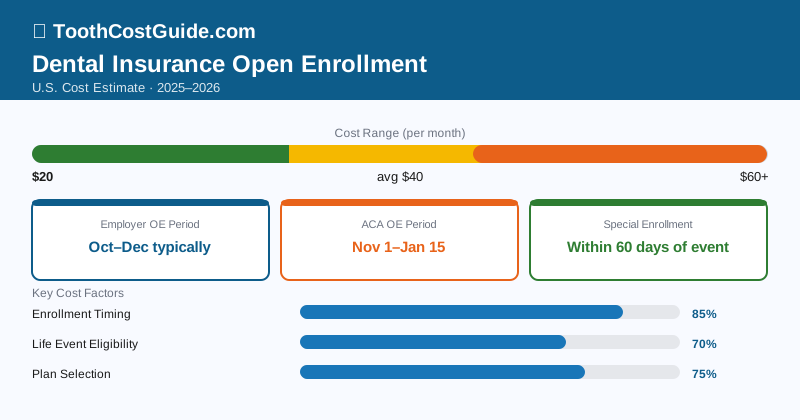
Choosing the wrong dental plan during open enrollment — or missing the window entirely — can cost you $500–$2,000 in the coming year. Open enrollment is your once-a-year opportunity to select or change dental coverage without needing a qualifying life event. Knowing the enrollment windows, what to compare, and how to evaluate your actual dental needs makes the difference between a plan that saves you money and one that doesn’t.
| Coverage Type | Open Enrollment Window | Plan Start Date | Change Allowed? |
|---|---|---|---|
| ACA marketplace dental | Nov. 1 – Jan. 15 | Jan. 1 (if enrolled by Dec. 15) | Yes, annually |
| Employer dental (typical) | Oct.–Nov. (varies by employer) | Jan. 1 (or plan anniversary) | Yes, annually |
| Medicare Advantage dental | Oct. 15 – Dec. 7 | Jan. 1 | Yes, annually |
| Individual off-exchange dental | Any time (no OE window) | Date of enrollment | Yes, anytime |
| Dental HMO (employer) | Same as employer OE | Same as employer | Yes, during OE |
| CHIP/Medicaid | Year-round | Based on approval | Year-round |
Open Enrollment Dates and Windows
ACA Marketplace (healthcare.gov) Open Enrollment:
- 2025–2026 open enrollment: November 1, 2025 – January 15, 2026
- Coverage effective dates: January 1, 2026 (if enrolled by December 15); February 1, 2026 (enrolled December 16–January 15)
- This window applies to both health plans AND standalone dental plans purchased on the marketplace
Employer-Sponsored Dental Open Enrollment:
- Dates set by each employer; typically October–November for January 1 coverage start
- Some employers have plan anniversaries other than January 1 — check with HR
- During open enrollment you can: add/drop dental coverage, switch between dental plan options, add or remove dependents
- Changes made outside open enrollment require a qualifying life event (QLE)
Medicare Advantage Open Enrollment:
- Annual Enrollment Period (AEP): October 15 – December 7
- Changes take effect January 1
- For seniors on Medicare, this is the window to switch to a Medicare Advantage plan with better dental benefits or to add/change a standalone Medicare dental plan
Individual Off-Exchange Dental (No Open Enrollment Restriction):
- Individual dental insurance sold directly by carriers (not on the ACA marketplace) typically has NO open enrollment restriction
- You can buy, change, or cancel individual dental plans at any time
- This is a major advantage of individual dental insurance over health insurance — you’re not locked into annual enrollment windows
- Plans like Spirit Dental, Delta Dental individual, Ameritas, and Cigna individual dental are available year-round
When off-exchange enrollment matters: If you miss the ACA marketplace open enrollment window, you can still buy a dental plan directly from a carrier at any time. For most dental needs, an off-exchange individual plan works equally well as a marketplace plan.
Individual dental insurance has no enrollment restrictions — you can buy it year-round from carriers directly. This is fundamentally different from health insurance. If you miss open enrollment for health coverage, you’re stuck; if you miss it for dental, you can still buy individual dental insurance directly from a carrier any day of the year.
What to Evaluate During Open Enrollment
Step 1: Assess your anticipated dental needs for the coming year.
Before comparing plans, think through what dental care you’re likely to need:
- Routine preventive care only (cleanings, X-rays)?
- Known upcoming fillings (1–3 expected)?
- Major work anticipated (crown, root canal, bridge)?
- Orthodontics for you or a dependent?
- Dentures or implants in the near future?
Your honest self-assessment determines which plan features matter most.
Step 2: Calculate the true cost of each plan option.
Don’t compare premiums alone. Compare total annual cost:
- Annual premium (monthly cost x 12)
- Estimated out-of-pocket for your anticipated procedures
- = Total annual cost
Example:
- Plan A: $30/month premium ($360/year) + $200 for anticipated filling + $0 for cleanings = $560 estimated total
- Plan B: $50/month premium ($600/year) + $200 for anticipated filling + $0 for cleanings = $800 estimated total
- For preventive-only use, Plan A is better by $240/year
But if a crown becomes necessary:
- Plan A (80% max, $1,000 annual max): Crown costs $1,400; plan pays $700; you pay $700. Total with premiums: $1,060
- Plan B (80% max, $2,000 annual max): Crown costs $1,400; plan pays $700; you pay $700. Total: $1,300
For heavy-use years, both plans are similar because the $1,000 vs. $2,000 max only matters if you have TWO major procedures.
Step 3: Compare annual maximums relative to your risk.
If your mouth is in good condition and you rarely need more than cleanings, a $1,000 annual maximum is fine. If you have older restorations that may need replacement or known upcoming major work, a $2,000 max is significantly more valuable.
Step 4: Check waiting periods for your situation.
If you’re a new enrollee (no prior dental coverage or coverage gap), waiting periods mean:
- 6 months: No coverage for fillings
- 12 months: No coverage for crowns, bridges, dentures, implants
If you have prior continuous coverage (no gap), you may be able to waive waiting periods. Have documentation ready.
Step 5: Verify your dentist is in-network.
Network participation matters more than brand. Before finalizing your plan choice, call your dentist’s office and confirm: “Do you accept [Plan Name] from [Insurer]?” Do this for every plan you’re seriously considering. Don’t rely solely on online directories.
Step 6: Check orthodontic benefits if applicable.
If a family member needs or may need braces in the next few years:
- Does the plan include orthodontic coverage?
- What is the lifetime maximum ($1,000? $2,000?)?
- What is the waiting period for orthodontics (often 24 months on individual plans)?
- Is adult orthodontic coverage included, or only children?
Special Enrollment Periods (SEPs)
Outside of open enrollment windows, you can enroll in marketplace dental coverage if you experience a qualifying life event. Common SEPs include:
- Loss of other coverage: You lost employer dental, COBRA dental, Medicaid, or CHIP coverage
- Marriage: New spouse can be added; changed household may qualify for new plan selection
- Having a baby or adoption: New dependent triggers a 60-day SEP
- Divorce: Affects household composition and coverage needs
- Moving to a new coverage area: Relocating to a state or county with different plan options
- Citizenship/immigration status change: Gaining lawful presence in the US
- Income change: Income change that affects ACA subsidy eligibility
SEP deadlines: You typically have 60 days from the qualifying event to enroll. Missing the 60-day window means waiting for the next open enrollment period (or purchasing off-exchange individual dental, which has no restrictions).
CHIP and Medicaid: These programs accept applications year-round with no open enrollment requirement. Income changes that qualify you for Medicaid or CHIP allow immediate enrollment at any time.
Employer Open Enrollment: What to Look For
Review the available plan options carefully. Many employers offer multiple dental plan options — often an HMO and a PPO. Don’t default to the same plan you had last year without evaluating whether your needs have changed.
Compare the Summary of Benefits for each option. Your employer must provide this document. Compare:
- Annual maximum
- Deductibles
- Coverage percentages for preventive, basic, major
- Orthodontic benefit (if relevant)
- Network size and whether your dentist participates
Evaluate dependent coverage costs. The employee-only premium is usually heavily subsidized by employers. Adding dependents often costs more than the employee adds. If dependents qualify for CHIP, they may be better covered (and cheaper) on CHIP than on your employer family plan.
Check if FSA enrollment is available. Many employers offer a Dental/Healthcare FSA alongside dental insurance during open enrollment. Contributing to an FSA lets you pay dental costs with pre-tax dollars, effectively reducing your out-of-pocket costs by 20–37%.
Ask about mid-year flex benefits. Some employers allow dental spending accounts, mid-year plan changes, or other flex options that can supplement your dental coverage.
How to Save Money During Open Enrollment
Don’t over-insure. If your last 3 years of dental costs were under $400/year (cleanings only), an expensive $50/month comprehensive plan isn’t delivering value. Match your plan level to your actual usage.
Upgrade coverage before anticipated major work. If your dentist has recommended a crown in the next 18 months, this open enrollment is your opportunity to switch to a plan with a higher annual maximum or better major work coverage — and start the waiting period clock (if applicable) running now.
Compare across all your household’s options. If both spouses have employer dental, compare both plans and choose the better one for any dependents. Sometimes one employer’s family dental is dramatically better than the other.
Take advantage of preventive dental before year-end. Open enrollment is often the reminder to schedule your second cleaning of the year before year-end. Use your current plan’s benefits fully before switching plans.
Enroll in FSA if available. An FSA allows you to contribute pre-tax dollars for dental expenses. In the 22% tax bracket, $1,500 in an FSA is effectively worth $1,830 in after-tax dollars. Use it for copays, deductibles, and out-of-pocket dental costs.
Dental open enrollment decisions have a 12-month impact. A plan that looks cheaper monthly may cost more annually if it has low annual maximums or high cost-sharing percentages. Model out 2–3 dental scenarios (light year, moderate year, heavy year) before choosing a plan — 20 minutes of math can save you hundreds.
Open enrollment for dental insurance is your annual opportunity to align your coverage with your actual dental needs. The key decisions: match the annual maximum to your expected needs, verify your dentist is in-network on every plan you consider, check waiting periods if you’re switching plans, and consider whether off-exchange individual dental (available year-round) might serve you better than marketplace or employer options.
Bottom Line
Dental insurance open enrollment windows depend on your coverage type: ACA marketplace (November 1 – January 15), employer plans (typically October–November), and Medicare Advantage (October 15 – December 7). Individual off-exchange dental plans can be purchased year-round without any enrollment restrictions. During open enrollment, focus on three key decisions: the right annual maximum for your anticipated needs, in-network verification for your preferred dentist, and waiting period status for upcoming major work. Model total annual costs — not just monthly premiums — before finalizing your choice.