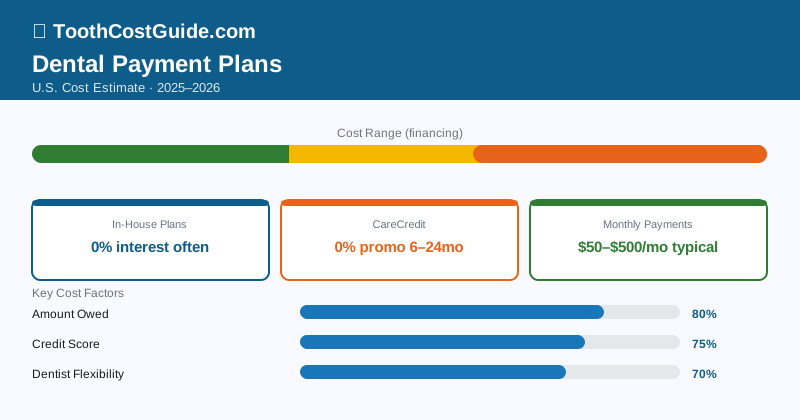
Breaking a large dental bill into monthly payments is one of the most practical ways to make necessary treatment affordable — many dental offices offer in-house payment plans with 0% interest for 3–12 months, turning a $3,000 crown and root canal into a manageable $250/month payment. Knowing how to ask and what to expect prevents you from defaulting to high-interest credit cards or third-party financing when better options exist at your dentist’s office.
| Payment Plan Type | Interest Rate | Term | Min. Amount | Approval Process |
|---|---|---|---|---|
| In-house dental office plan | 0% (often) | 3–12 months | Varies ($300+) | No credit check (usually) |
| CareCredit promotional period | 0% deferred | 6–24 months | $200+ | Soft/hard credit check |
| Scratchpay | 0–29.99% APR | 3–48 months | $200+ | Soft credit check |
| LendingClub Patient Solutions | 0–35.99% APR | 24–84 months | $500+ | Hard credit check |
| Alphaeon Credit | 0–29.99% APR | 6–60 months | Varies | Hard credit check |
| Personal bank loan | 7–20% APR | 12–60 months | $1,000+ | Credit check required |
How It Works
In-house payment plans are informal or semi-formal agreements between you and your dental practice. The office essentially extends you credit and collects directly, eliminating the cost and complexity of third-party financing companies. Because the dentist knows you personally, many offices are more flexible than a credit company would be.
Typical in-house terms:
- No or low interest for 3–6 months
- Down payment of 25–50% required
- Remaining balance split into equal monthly payments
- Auto-pay via credit card or bank draft often required
- Late fees may apply (usually $25–$35)
Third-party dental financing (CareCredit, Scratchpay) is offered through the dental office but issued by a bank or lender. These often feature promotional 0% APR periods that can extend up to 24 months for large treatment amounts, but deferred interest traps are common — read the fine print.
Costs & Savings Details
The primary benefit of a payment plan isn’t saving money in total — it’s making necessary care financially accessible without taking on high-interest debt.
Where payment plans save real money:
- Avoiding a credit card at 22–29% APR on a $3,000 dental bill saves $660–$870 in interest if it would take 12 months to pay off
- Getting necessary treatment now (before a filling becomes a root canal) saves $800–$1,200 in escalating care costs
- Avoiding emergency room visits for dental pain (average ER cost: $800–$1,500 for treatment that doesn’t fix the problem) saves hundreds
CareCredit deferred interest warning: CareCredit’s “deferred interest” promotion means if you carry any balance at the end of the promotional period, all the interest that would have accrued from day one is charged to you at once. On a $4,000 balance at 26.99% APR over 18 months, that retroactive charge can be $700–$1,200. Only use deferred-interest promotions if you are certain you can pay the balance in full before the period ends.
Eligibility / Who Qualifies
In-house payment plans: Qualification is at the dentist’s discretion. Practices typically require:
- A down payment (usually 25–50% of treatment cost)
- Established patient relationship (some practices require prior visits)
- Agreement to auto-pay
- Some practices run a soft credit check; most do not
CareCredit / Alphaeon: Require a credit application. Approval depends on your credit score and income. Patients with fair credit (580–669) may be approved for limited amounts or higher APRs.
Scratchpay: Uses a soft credit pull initially. Offers are based on credit profile. Some applicants receive 0% offers; others receive offers with APRs starting at 10–29.99%.
Patients with poor credit: In-house plans are your best bet. Some dental offices specifically serve uninsured and credit-challenged patients and are accustomed to working out creative arrangements.
Pros and Cons
Pros
- Makes large dental bills manageable without upfront cash
- In-house plans often have no interest and no credit check
- Enables necessary treatment that would otherwise be delayed
- Multiple financing options available for different credit profiles
Cons
- Third-party financing (especially deferred-interest) can be expensive if mismanaged
- In-house plans require dentist to absorb the credit risk — not all offices offer them
- No payment plan reduces the total amount owed (unlike negotiation or insurance)
- Default on in-house plan can damage your relationship with the practice
“Deferred interest” is not the same as “0% interest.” With deferred interest, you owe all the interest if you don’t pay the full balance by the promotional period end date. True 0% interest means no interest accrues — a much better deal. Always ask which type you’re being offered.
Step-by-Step Guide
Ask before agreeing to treatment: When presented with a treatment plan and cost estimate, say: “I’d like to have this done, but I need to work out payment. Do you offer payment plans in-house, or do you have financing options?”
Request in-house payment terms first: In-house plans are often the best deal. Ask: “If I put down $X today, could we spread the rest over 3–6 months with no interest?” A down payment of 30–50% makes in-house approval much more likely.
Set up auto-pay: Offer to give your credit card or bank account information for automatic monthly payments. This reduces the dentist’s collection risk and makes approval easier.
Get the terms in writing: Ask for a written payment agreement specifying the total amount, down payment, monthly payment, due date, interest rate (or confirmation of 0%), and any late fees.
Evaluate CareCredit or Scratchpay if needed: If the office doesn’t offer in-house plans, apply for CareCredit or Scratchpay. For CareCredit, only use it if you can pay the full balance before the promotional period ends. Set a calendar reminder 30 days before the deadline.
Consider a personal loan for large amounts: For treatment over $5,000, compare rates from credit unions or banks. A 9% personal loan is significantly cheaper than a 27% deferred-interest credit card if you can’t pay in full within the promotional period.
Prioritize treatment urgency: If you can’t afford everything at once, ask your dentist to help you prioritize. Infections, severe pain, and decay that threatens adjacent teeth should come first. Cosmetic or elective work can wait.
Call the office manager before your appointment and say: “I’d like to discuss payment options before I come in — I want to make sure I can move forward with treatment.” This opens the conversation professionally and gives the office time to prepare options for you, rather than putting you on the spot at checkout.
Bottom Line
Dental payment plans are widely available and, when structured as in-house 0% interest arrangements, carry no extra cost beyond the care itself. The key is asking before treatment begins, offering a meaningful down payment to make in-house approval easy, and getting all terms in writing. Avoid deferred-interest third-party financing unless you’re absolutely certain you can pay the full balance before the promotional period expires. For large procedures like implants or full dentures, a personal loan from a credit union may offer the most transparent and affordable terms.