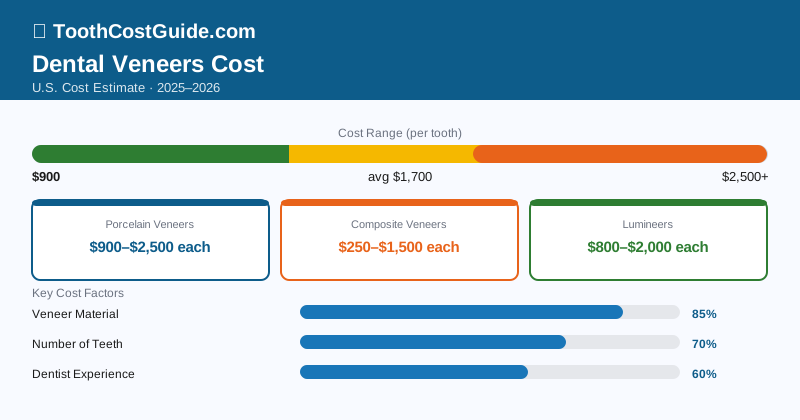
Porcelain veneers cost $900–$2,500 per tooth without insurance. Composite resin veneers run $250–$600 per tooth. A full smile makeover with 8–10 porcelain veneers on upper front teeth typically costs $7,200–$25,000 at private cosmetic dental practices. Because veneers are considered elective cosmetic treatment, dental insurance almost never covers them.
| Veneer Type | Cost Per Tooth |
|---|---|
| Composite resin (direct, in-office) | $250–$600 |
| Porcelain (traditional, lab-fabricated) | $900–$2,500 |
| Lumineers / no-prep thin veneers | $800–$2,000 |
| Snap-on / removable veneers | $300–$1,500 total |
| 4-veneer set (composite) | $1,000–$2,400 |
| 8-veneer set (porcelain) | $7,200–$20,000 |
| 10-veneer full smile (porcelain) | $9,000–$25,000 |
What Affects the Cost of Dental Veneers
Porcelain vs. composite. The material difference is the biggest cost driver. Porcelain veneers are fabricated in a dental lab from ceramic — custom shaded, shaped, and fired to match your desired appearance. They’re highly esthetic, stain-resistant, and last 10–20 years. Composite veneers are applied directly to the tooth by the dentist in a single appointment using resin bonding material. They’re faster and cheaper, but more prone to staining, chipping, and discoloration over 5–7 years.
Number of veneers. Most cosmetic smile cases treat 6–10 upper front teeth for a consistent, uniform appearance. Treating only 1–2 teeth while leaving natural neighbors untouched can be challenging for shade matching — cosmetic dentists may recommend treating more teeth to achieve a natural result.
Dentist’s expertise and location. Cosmetic dentistry is a skill-intensive, unregulated specialty. Highly experienced cosmetic dentists in major cities charge $1,800–$2,500 per porcelain veneer. General dentists with cosmetic training in mid-size markets may charge $900–$1,400. The skill differential is real — view extensive before/after case photos before choosing a provider.
Whether tooth preparation is required. Traditional veneers require removing 0.3–0.5mm of enamel from the front of each tooth — an irreversible process. No-prep or minimal-prep veneers (Lumineers, DURAthin) require little to no tooth reduction, but their thin profile is only suitable for specific cases and may look less natural than traditional veneers.
Porcelain veneers are a permanent, irreversible cosmetic procedure. Once enamel is removed for traditional veneers, those teeth will always require restorations — they cannot go back to unrestored enamel. Be certain about your goals before proceeding.
Composite vs. Porcelain Veneers: Which Is Right for You?
Composite veneers — best for:
- Budget-conscious patients ($250–$600/tooth vs. $900–$2,500/tooth)
- Patients who want to “test” a new smile before committing to porcelain
- Minor chips, small gaps, or slight discoloration
- Patients who may need future adjustments (composite can be repaired; porcelain cannot)
- Lifespan: 5–7 years with proper care, then require replacement or repair
Porcelain veneers — best for:
- Patients seeking the most natural, durable result
- Significant color correction, shape changes, or closing large gaps
- Long-term commitment to cosmetic investment
- People who want stain resistance (coffee, wine, tea)
- Lifespan: 10–20 years with good oral hygiene and no habits like nail-biting or teeth-grinding
Lumineers / no-prep veneers: Marketed as reversible because minimal tooth reduction is needed. In reality, they require more bulk to compensate for the lack of tooth reduction and can look opaque or bulky on some patients. Best for very specific clinical situations; not universally superior to traditional veneers.
With vs. Without Dental Insurance
Dental insurance does not cover porcelain or composite veneers. Veneers are classified as cosmetic (elective) treatment and are explicitly excluded from coverage in virtually all dental insurance policies.
Exception: If a front tooth is fractured due to trauma and a veneer is the clinically indicated restoration, insurance may cover it under accident/trauma benefits. This is rare and claim-specific.
FSA/HSA: Generally, FSA and HSA funds cannot be used for cosmetic procedures with no medical purpose. However, if a veneer is needed due to trauma or structural damage (not purely cosmetic), it may qualify as a medical expense. Check your plan administrator’s guidance.
Bottom line on insurance: For veneers, budget the full cost out of pocket or through financing. Don’t factor insurance into the calculation.
How to Save Money on Dental Veneers
Consider composite veneers first. A skilled cosmetic dentist can create excellent results with composite resin at $250–$600/tooth — a fraction of porcelain cost. Many patients are genuinely satisfied with composite veneers for 5–7 years before upgrading to porcelain. This is an especially smart strategy for younger patients whose smile preferences may still evolve.
Dental school cosmetic clinics. Advanced dental school programs and prosthodontic residencies occasionally offer cosmetic veneer treatments at reduced fees. Availability is limited and waitlists exist, but savings of 40–60% are possible for patients willing to be treated as educational cases.
Negotiate case pricing. For 8–10 veneer cases, many cosmetic dentists offer a per-tooth discount for larger cases. A dentist who charges $1,800/tooth individually might price a 10-veneer case at $1,400/tooth — a $4,000 total reduction. Always ask about volume pricing.
Travel to a different market. Cosmetic dentistry fees vary significantly by market. A dentist in Austin or Atlanta may charge $1,100/tooth for porcelain veneers that cost $2,200/tooth in Manhattan. If you can travel for treatment, you may access equivalent skill at half the price.
Request a digital smile design or wax-up mock-up before committing to porcelain veneers. Reputable cosmetic dentists provide a digital preview or a temporary composite mock-up of your new smile so you can approve the look before any permanent tooth reduction occurs. If a dentist skips this step, reconsider.
Financing Options
Veneer treatment — being fully out-of-pocket and running $5,000–$25,000 for comprehensive cases — almost always involves financing.
CareCredit: Widely accepted by cosmetic dental practices. For amounts over $2,500, 18–24 month 0% promotional periods are typically available. For large cases over $10,000, 48–60 month financing with stated APRs (not deferred) may be available. Understand the terms completely.
Dental office in-house financing: Many cosmetic-focused practices work with multiple financing partners (CareCredit, Alphaeon, Proceed Finance) to offer competitive options. Some offer their own payment plans.
Personal loans: For larger veneer cases ($8,000–$20,000), a personal loan from a credit union or bank often offers lower APR than credit card financing. Compare rates at LightStream, SoFi, or local credit unions before signing up for dental-specific financing.
Staged treatment: You don’t need to veneer all teeth at once. Starting with the 2–4 most visible front teeth, then adding more later, spreads the cost across multiple years.
Bottom Line
Porcelain veneers cost $900–$2,500 per tooth, with full-smile cases running $7,200–$25,000. Composite veneers offer a budget-friendly alternative at $250–$600 per tooth with acceptable cosmetic results for 5–7 years. Neither type is covered by dental insurance.
Veneers are an investment in your confidence and smile — but they’re a permanent, irreversible commitment. Take your time choosing a dentist with extensive cosmetic experience, view detailed case portfolios, insist on a digital preview or mock-up, and ensure you fully understand what the process entails before enamel is removed.
Always get a written treatment plan before agreeing to any dental work. For veneers, confirm whether your case requires tooth preparation (enamel removal), how many try-in appointments are included, what the warranty or guarantee covers, and what happens if a veneer chips or debonds within the first year.