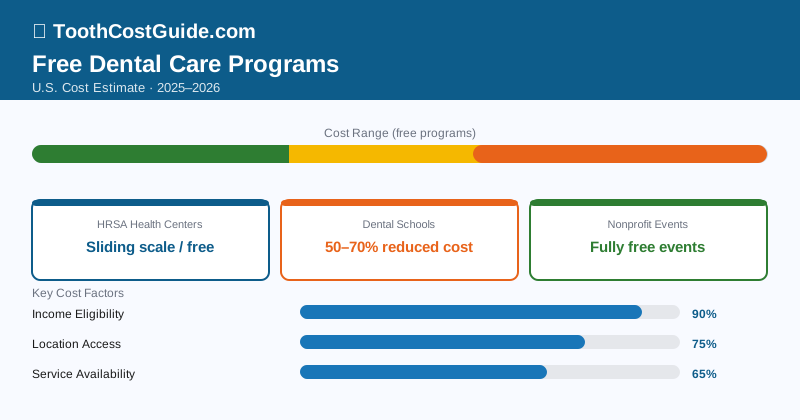
Free dental care is available to millions of Americans through national events, nonprofit organizations, and government-backed programs — saving individuals $200 to $3,000+ per visit. Knowing where to look and how to qualify is the difference between suffering with untreated pain and walking away with extractions, fillings, and cleanings at zero cost.
| Program Type | Services Typically Offered | Who Qualifies | Typical Savings |
|---|---|---|---|
| Give Kids A Smile events | Cleanings, X-rays, sealants, fillings | Children 0–18 | $200–$600 per child |
| Mission of Mercy clinics | Extractions, fillings, cleanings | All ages, low income | $500–$3,000 per visit |
| America’s Dentistry Day | Basic care, checkups | All ages | $100–$400 |
| Remote Area Medical (RAM) | Full-scope dental + medical | Low-income adults | $300–$2,500 |
| Delta Dental Foundation events | Preventive care | Varies by event | $100–$500 |
| Federally Qualified Health Centers | Full range, sliding scale | Income-based | 40–80% discount |
How It Works
Free dental programs operate through a combination of volunteer dentists, donated supplies, and nonprofit or government funding. Most fall into three categories:
One-day or weekend clinic events bring together dozens of volunteer dentists in a single location — often an arena, fairgrounds, or convention center — to treat as many patients as possible in a short window. Patients typically queue early in the morning (sometimes the night before) and are seen on a first-come, first-served basis. These events can serve 500–2,000 people over a single weekend.
Ongoing nonprofit programs such as Give Kids A Smile (run by the American Dental Association Foundation) operate through local dental offices and dental school events throughout the year. Dentists participate voluntarily and absorb the cost of treatment.
Federally funded health centers (FQHCs) provide dental care year-round on a sliding-fee scale based on income, which can result in $0 to very low-cost care for qualifying patients. These are the most reliable source of ongoing free or near-free dental care.
Costs & Savings Details
At major free clinic events, patients routinely receive care worth $500–$3,000 in a single day:
- Mission of Mercy events (organized by state dental associations) have provided over $55 million in free care since 2000, with individual patients receiving $800–$2,500 in treatment on average.
- Remote Area Medical (RAM) serves rural and underserved populations, with dental care valued at $300–$1,500 per patient per event.
- Give Kids A Smile has served over 6 million children since 2003, with average per-child savings of $200–$400 per event.
- FQHCs use a sliding fee scale: a family of four at 100% of the federal poverty level ($31,200/year in 2025) typically pays $0–$20 for a cleaning and exam versus $150–$250 at a private dentist.
Eligibility / Who Qualifies
Eligibility varies by program:
- Give Kids A Smile: Children ages 0–18, often with priority for underserved or uninsured children. No income test at most events.
- Mission of Mercy / RAM / America’s Dentistry Day: Open to all uninsured or underinsured Americans. Low-income status is preferred but not always required. First-come, first-served.
- FQHCs: Anyone can receive care regardless of ability to pay. Sliding-scale fees are based on household income and family size, using federal poverty level guidelines. Patients at or below 200% of the federal poverty level typically pay the lowest fees.
- State dental charity events: Requirements vary; check your state dental association’s website.
Children and seniors are most frequently targeted by dedicated programs, but adults of all ages are served at large one-day clinics.
Pros and Cons
Pros
- Completely free or very low cost
- No insurance required
- Services can include complex procedures (extractions, fillings, root canals at some events)
- No credit check or repayment obligation
Cons
- One-day events are sporadic and require arriving very early — lines can form at 4–5 a.m.
- Limited availability by geography — rural areas may have few options
- Treatment is often emergency-focused; cosmetic or elective work is not provided
- Ongoing, complex treatment plans are not typically possible in a single visit
Free dental events cannot replace regular dental care. They are designed for acute needs — tooth pain, infection, broken teeth. If you have ongoing dental disease, explore FQHCs or dental schools for consistent care.
Step-by-Step Guide
Find local events: Search “Mission of Mercy [your state]”, “RAM clinic [your city]”, or visit the ADA Foundation website (adafoundation.org) for Give Kids A Smile events. The National Association of Free & Charitable Clinics (nafcclinics.org) maintains a searchable map.
Locate your nearest FQHC: Visit findahealthcenter.hrsa.gov and enter your zip code. Call ahead to confirm dental services are available and ask about the sliding-fee application process.
Check your state dental association: Most state associations (e.g., California Dental Association, Texas Dental Association) maintain lists of free and low-cost dental programs. Search “[State] Dental Association free clinic.”
Prepare for event-day clinics: Arrive early — ideally 1–2 hours before doors open. Bring a photo ID and any insurance cards you have (even if you’re uninsured, having Medicaid can help). Know your medical history, especially medications and allergies.
Apply for FQHC sliding fees: When you call or visit an FQHC, ask about their sliding fee discount program. Bring proof of income (pay stubs, tax return, or a self-attestation form if you have no income) and proof of household size.
Sign up for dental school clinics: Accredited dental schools (see dental-schools-near-me.md) provide free or low-cost care year-round. Treatments take longer but are supervised by licensed faculty.
Register with local nonprofits: Organizations like Dental Lifeline Network (dentallifeline.org) run the Donated Dental Services (DDS) program, matching elderly, disabled, or medically compromised adults with volunteer dentists for free comprehensive care.
The Donated Dental Services (DDS) program through Dental Lifeline Network is one of the most overlooked free dental resources in the U.S. It serves adults who are elderly, have a permanent disability, or are medically fragile — matching them with volunteer dentists for comprehensive (not just emergency) care. Apply at dentallifeline.org.
Bottom Line
Free dental care exists across the country — but it requires knowing where to look and acting quickly. For children, Give Kids A Smile events are widely available and no-cost. For adults in financial need, Mission of Mercy clinics and RAM events provide the most comprehensive one-day treatment. For ongoing, reliable care at reduced cost, FQHCs are the gold standard — they serve over 30 million patients annually and are available in every state. Start your search at findahealthcenter.hrsa.gov or your state dental association’s website.