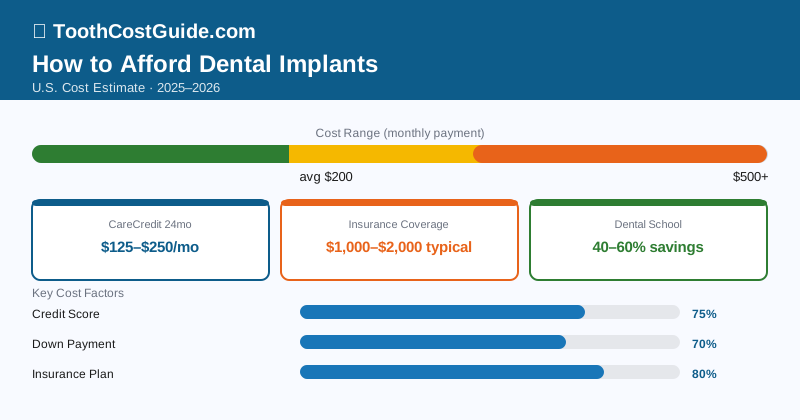
A single dental implant costs $3,500–$6,000 at a private US dental office — but patients who combine multiple cost-reduction strategies can reduce that to $1,200–$2,500, a savings of $1,500–$3,500+ per implant. The key is knowing which combination of insurance, financing, alternative care settings, and geography works for your situation.
| Strategy | Typical Savings | Out-of-Pocket Range |
|---|---|---|
| Dental insurance (implant coverage) | $1,000–$1,500 per implant | $2,500–$4,000 |
| Dental school (US) | 40–60% off | $1,500–$2,500 |
| HSA/FSA tax savings | 22–37% effective discount | $2,800–$4,000 |
| In-house dental membership plan | 15–25% off | $2,600–$4,500 |
| Dental tourism (Mexico) | 55–70% off | $1,100–$1,800 |
| Dental tourism (Costa Rica) | 45–65% off | $1,400–$2,200 |
| Payment plan (no interest) | No savings, but accessible | Full price in installments |
| Combination: school + HSA | ~55–65% total | $1,500–$2,200 |
How It Works
Dental implants are a three-stage process: implant placement (titanium post surgically placed into bone), healing period (3–6 months of osseointegration), then crown attachment. Each stage represents a separate cost — and each offers a separate opportunity to reduce expense.
Most cost-reduction strategies don’t conflict with each other. You can use dental school for placement, pay with HSA funds (saving 22–30% on taxes), and apply whatever partial insurance coverage you have. Combining strategies is the key to making implants truly affordable.
Costs & Savings Details
Full implant cost breakdown (national average 2025):
- Implant post (surgical placement): $1,500–$2,500
- Abutment (connector): $300–$500
- Crown (the visible tooth): $1,200–$1,800
- Bone graft (if needed): $500–$3,000
- CT scan/imaging: $150–$500
- Total without bone graft: $3,500–$5,500
- Total with bone graft: $4,500–$8,000
Insurance coverage: As of 2025, approximately 40% of employer-sponsored dental plans include some implant coverage — typically paying 50% of the implant post up to the plan’s annual maximum ($1,000–$2,000). This means maximum insurance savings of $500–$1,500 per implant. Plans with implant coverage typically have a 12–24 month waiting period.
Dental school savings: University dental school clinics charge 40–60% less for implant procedures. At major programs (UCLA, NYU, University of Michigan), a full implant including crown runs $2,000–$3,200. Treatment takes longer due to the educational setting but is supervised by experienced faculty.
Dental tourism (Mexico): A full implant in Los Algodones or Tijuana using Tier-1 brands (Nobel Biocare, Straumann) costs $1,200–$1,900 all-in. Add $300–$600 for travel from the Southwest and you’re still saving $1,500–$2,500 vs. US prices.
Eligibility / Who Qualifies
For dental school treatment: Anyone who meets the clinic’s clinical criteria. Schools accept patients with adequate bone density and good overall health. More complex cases (heavy smokers, uncontrolled diabetes, severe bone loss) may be triaged differently. Call the dental school clinic admissions line.
For insurance coverage: Review your plan documents specifically. Look for CDT codes D6010 (implant body), D6065 (implant-supported metal-ceramic crown), D6190 (implant index). If those codes appear in the “covered procedures” section, you have coverage.
For HSA/FSA: All dental implants for replacing missing teeth are qualified medical expenses. Purely cosmetic dental implants (replacing teeth that don’t affect function) are a gray area — consult your tax advisor.
For dental tourism: Any US citizen in good enough health to travel. Discuss medical conditions with the treating clinic in advance.
Pros and Cons
Pros of getting implants at all:
- Prevent bone loss and shifting of adjacent teeth
- Most natural-feeling tooth replacement
- 20–30 year lifespan with proper care
- Avoid the ongoing costs of bridges and dentures
Pros of cost-reduction strategies:
- Dental school: High-quality, supervised care at 40–60% off
- Insurance + HSA: Can legitimately cut cost in half
- Dental tourism: Largest absolute savings for well-researched patients
Cons:
- Dental school: Treatment takes much longer (6–18 months for full implant)
- Insurance: Annual maximums ($1,500–$2,000) limit benefit for major procedures
- Dental tourism: Complications are managed abroad or at full US price domestically
Avoid “implant discount” deals advertised on social media or in mailers promising $999 implants. These often use inferior implant brands, cut corners on imaging, or hide fees for the abutment and crown. A complete implant procedure has multiple legitimate costs — a suspiciously low all-in price usually means something is being left out.
Step-by-Step Guide
Get a comprehensive treatment plan with itemized CDT codes: Before doing anything else, have a consultation and get a written treatment plan showing each procedure code, unit cost, and total. This is your starting point for comparing alternatives.
Check your dental insurance for implant coverage: Review your Explanation of Benefits (EOB) documents or call your insurer. Ask specifically: “Do you cover CDT code D6010 or dental implants? What is my benefit after any waiting period? What is my annual maximum?”
Verify you have adequate bone density: Most implant decisions depend on a cone beam CT scan (CBCT). This can be done at the dental school or an oral surgeon’s office. Without adequate bone, a bone graft is needed — add that cost to your planning.
Apply to your nearest dental school clinic: Search “dental school near me” or check the American Dental Education Association’s school finder (adea.org). Call the clinic line and ask about implant cases, current wait times, and fees.
Calculate your HSA/FSA contribution: If you have an HSA, maximize your contribution in the year you’ll need implant work. If you have an FSA, elect the maximum $3,300 for the year of your surgery.
Get quotes from 2–3 providers: Compare your local dentist, the dental school, and (if you’re interested in dental tourism) 2–3 reviewed clinics in Los Algodones or Tijuana. Request written, itemized quotes from each.
Arrange financing for any remaining balance: After applying insurance and tax savings, use in-house payment plans or Scratchpay for the remainder. Avoid high-APR deferred-interest financing for amounts you can’t repay within the promotional period.
If you need multiple implants, the per-implant cost at a dental school drops further because placement appointments can often be combined, reducing facility and anesthesia fees. Students also receive credit for additional cases, which motivates high-quality work. For 4+ implants, dental school is often the single best combination of quality and cost.
Bottom Line
Dental implants don’t have to cost $5,000 out of pocket. A patient combining dental school treatment (~$2,500), HSA pre-tax payment (~25% savings on $2,500 = $625 reduction), and whatever insurance benefit applies can bring an implant’s true cost below $2,000. For patients willing to travel, quality dental tourism to Mexico brings the total to $1,200–$1,800 all-in. The worst approach is putting a $5,000 implant on a 27% APR credit card with no plan — that decision can cost $6,500+ over time.