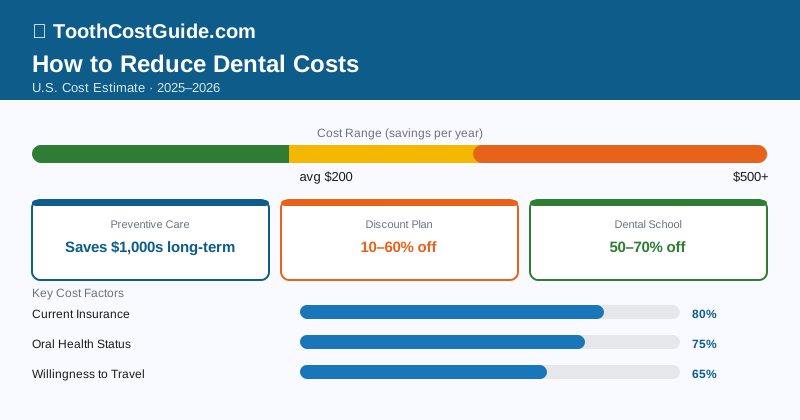
The average American family spends $1,200–$2,500 on dental care annually, but most are unaware of strategies that can cut that figure by 30–70%. This guide covers all 15 proven cost-reduction approaches — from simple insurance hacks to major savings opportunities most patients never consider.
| Strategy | Potential Savings | Effort Required | Best For |
|---|---|---|---|
| 1. Maximize dental insurance benefits | $200–$1,500/year | Low | Insured patients |
| 2. Open/max out HSA or FSA | 22–37% on all dental | Low | Employed workers |
| 3. Choose an in-house membership plan | 15–25% + free preventive | Low | Uninsured regulars |
| 4. Use dental school clinics | 40–65% per procedure | Medium | Any patient |
| 5. Find a community health center | Up to 100% (income-based) | Low | Low-income patients |
| 6. Negotiate cash-pay discounts | 10–20% | Low | Self-pay patients |
| 7. Get second opinions | $500–$3,000 per episode | Low | Before major work |
| 8. Attend free dental clinics | $200–$3,000/visit | Medium | Uninsured, any income |
| 9. Dental tourism (Mexico/Costa Rica) | 40–70% | High | Major procedures |
| 10. Treat problems early | 10x ROI on prevention | Low | Everyone |
| 11. Ask about material alternatives | 20–40% on materials | Low | Filling/crown patients |
| 12. Compare prices across providers | 20–40% on same service | Medium | Any patient |
| 13. Use flexible payment plans | 0% financing | Low | Budget-constrained |
| 14. Check Medicaid/CHIP eligibility | Up to 100% | Low | Low-income families |
| 15. Review and dispute bills | $50–$500 per correction | Medium | After major treatment |
How It Works
Reducing dental costs requires a layered approach. No single strategy cuts costs 70% on its own — but combining 3–5 of these strategies simultaneously can achieve dramatic reductions. The most successful dental cost-reducers know their insurance plan’s weak spots, pay with pre-tax money, comparison-shop providers, and seek second opinions before expensive treatment.
Costs & Savings Details
1. Maximize Dental Insurance Benefits
Most Americans with dental insurance use only 30–50% of their annual benefit. Strategies:
- Schedule your second cleaning in December if you haven’t used it — unclaimed cleanings are money left behind
- Time major work across two plan years to use two separate annual maximums ($1,000 + $1,000 = $2,000 vs. a single year’s $1,000 cap)
- Understand your plan’s waiting period status — if you just joined, know which procedures are covered now vs. after 6 or 12 months
- Check if your plan covers a second opinion on expensive treatment — many do
2. Open/Maximize HSA or FSA
Pre-tax payment reduces your real cost by 22–37%. Every dental dollar spent from an HSA or FSA is a dollar you didn’t pay income tax on. Contribute the maximum ($4,300 individual / $8,550 family for HSA; $3,300 for FSA) in years when you have significant dental work planned.
3. In-House Dental Membership Plans
Independent dental offices increasingly offer direct-pay membership plans for $150–$400/year. These typically include 2 free cleanings + exams and 15–25% discounts on all other procedures. For an uninsured patient spending $800/year on dental care, a $300 membership plan + 20% discount reduces costs by $160 on top of the “free” cleanings.
4. Dental School Clinics
Academic dental clinics charge 40–65% less than private practices. Treatment takes longer due to the educational setting but is supervised by licensed faculty dentists. For major work (crowns, root canals, dentures, implants), the savings are $400–$2,000+ per procedure.
5. Community Health Centers
FQHCs provide dental care on a sliding-fee scale. Patients at 100% of the federal poverty level pay $0–$20 for most procedures. Available in every state. Find one at findahealthcenter.hrsa.gov.
6. Cash-Pay Discount Negotiation
Independent dental offices earn roughly 60–80% of their fees from insurance, which involves significant administrative costs. A cash-paying patient who doesn’t file insurance is worth more per dollar collected. Ask for a self-pay discount of 10–15% when paying in full on the day of service.
7. Get Second Opinions
Studies show 10–30% of expensive dental treatment recommendations are either unnecessary or have lower-cost alternatives. Spending $50–$150 on a second opinion before a $2,000 crown placement or $5,000 implant can save thousands. Bring your X-rays and ask specifically: “Is this necessary right now, and is there a less expensive option?”
8. Attend Free Dental Clinics
Mission of Mercy, RAM, and Dentistry From The Heart events provide hundreds to thousands of dollars in free treatment. Find events at ramusa.org and dentistryfromtheheart.org.
9. Dental Tourism
For major procedures (implants, crowns, All-on-4), dental tourism to Mexico or Costa Rica saves 40–70%. A single All-on-4 arch that costs $25,000–$35,000 in the US runs $8,000–$16,000 in Los Algodones or San José.
10. Treat Problems Early
The escalation cost of delayed treatment is severe: a $200 filling becomes a $2,400 root canal + crown if neglected for 2 years. Attending regular cleanings and treating cavities immediately is the highest-ROI cost-saving strategy in dentistry.
11. Ask About Material Alternatives
Amalgam (silver) fillings cost 40–50% less than composite (tooth-colored) fillings. For back molars where aesthetics matter less, amalgam is a perfectly valid choice. Ask your dentist: “Is amalgam appropriate here? What’s the price difference?”
12. Compare Prices Across Providers
Dental fees for the same procedure vary 30–50% between practices in the same city. Use Fair Health Consumer (fairhealthconsumer.org) to see the range of fees in your zip code. Call 2–3 offices to compare costs for specific procedure codes before committing.
13. Use Flexible Payment Plans
Interest-free payment plans (in-house or through Scratchpay) let you spread a large dental bill without increasing your total cost. Converting a $3,000 bill into 12 monthly payments of $250 at 0% interest makes treatment accessible without adding cost.
14. Check Medicaid/CHIP Eligibility
34 states provide adult Medicaid dental; all states cover children through CHIP. A family of 4 earning up to $62,000–$90,000 may qualify for children’s CHIP dental benefits. Check at healthcare.gov.
15. Review and Dispute Bills
Billing errors occur in an estimated 25–40% of dental bills. Common issues: duplicate charges, wrong procedure code, charge for a service that was modified or cancelled. Review every itemized bill line by line and compare to what was performed.
Pros and Cons
Pros
- Most strategies require little to no effort to implement
- Multiple strategies can be combined for multiplicative savings
- No single strategy requires giving up quality of care
Cons
- Some strategies require advance planning (insurance enrollment, HSA, dental school scheduling)
- Dental tourism involves significant logistics
- Price comparison requires time and effort
The worst way to reduce dental costs is to skip care. Deferred treatment escalates costs exponentially. The 15 strategies in this guide are about getting necessary care for less — not avoiding care altogether.
Step-by-Step Guide
Assess your situation: Do you have insurance? Low income? Large treatment needed now? Your starting point determines which strategies apply.
Claim all insurance benefits this year: Log into your insurance portal and verify you’ve used both cleanings, your deductible status, and your remaining benefit balance.
Open HSA/FSA or maximize contributions: Do this during open enrollment if you haven’t already.
Get a written treatment plan before any major work: This lets you comparison-shop and seek second opinions.
Apply one or more of the 15 strategies to your specific situation: Use the table above to select the highest-savings options that fit your circumstances.
Stack strategies where possible: Cash discount + HSA + dental school = 60%+ reduction on major work.
The highest-leverage combination for most middle-income patients: (1) maximize your HSA contribution, (2) use a dental school for any procedure over $800, and (3) negotiate a cash-pay discount. Together, these three strategies can reduce your net cost on major dental work by 55–65% compared to paying full retail at a private dental office.
Bottom Line
Reducing dental costs is not about cutting corners on care — it’s about being a smarter consumer. The 15 strategies in this guide collectively represent thousands of dollars in annual savings for millions of Americans who simply haven’t heard of them. Start by picking the 3–4 strategies that best match your income, insurance status, and dental needs. Implement them consistently, and your dental costs will be dramatically lower over time without any reduction in the quality of your care.