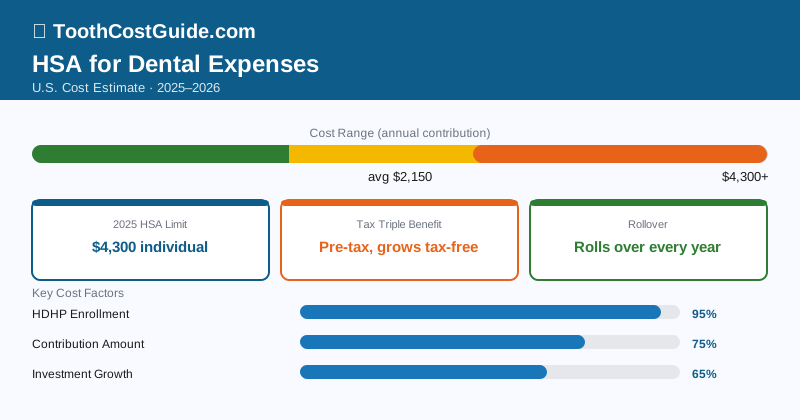
An HSA (Health Savings Account) effectively reduces your dental costs by 22–37% because you pay with pre-tax dollars — meaning a $1,000 crown actually costs you $630–$780 in real money. If you have a high-deductible health plan, maxing out your HSA and using it for dental expenses is one of the most powerful tax-advantaged moves available to Americans.
| 2025 HSA Contribution Limits | Amount |
|---|---|
| Individual coverage | $4,300/year |
| Family coverage | $8,550/year |
| Catch-up contribution (age 55+) | +$1,000/year |
| Employer contribution (counts toward limit) | Varies |
| HSA investment growth | Tax-free |
| Withdrawals for qualified expenses | Tax-free |
How It Works
An HSA is a tax-advantaged savings account available to people enrolled in a qualifying High-Deductible Health Plan (HDHP). The triple tax benefit is unique:
- Contributions are pre-tax (reduce your taxable income)
- Growth is tax-free (money can be invested in mutual funds, index funds, etc.)
- Withdrawals for qualified expenses are tax-free
For dental expenses, this means every dollar you spend from your HSA goes further. If you’re in the 22% federal tax bracket plus 5% state tax, you’re effectively getting a 27% discount on every eligible dental procedure you pay for with HSA funds.
HDHP requirements to open an HSA (2025):
- Minimum deductible: $1,650 for self-only, $3,300 for family
- Maximum out-of-pocket: $8,300 for self-only, $16,600 for family
Costs & Savings Details
Tax savings examples (assuming 24% federal + 5% state = 29% marginal rate):
| Procedure | Dental Cost | HSA Tax Savings | Your Effective Cost |
|---|---|---|---|
| Crown | $1,400 | $406 | $994 |
| Implant | $4,500 | $1,305 | $3,195 |
| Root canal | $1,200 | $348 | $852 |
| Dentures (full) | $3,000 | $870 | $2,130 |
| Annual cleanings (2) | $300 | $87 | $213 |
| Orthodontics (braces) | $5,000 | $1,450 | $3,550 |
Investment growth bonus: HSA funds you don’t spend grow tax-free. If you invest HSA contributions in index funds for 10–20 years, the account can grow significantly, creating a large reserve for dental (and other medical) expenses in retirement.
Eligibility / Who Qualifies
To contribute to an HSA, you must:
- Be enrolled in an HSA-qualifying HDHP
- Not be covered by any other non-HDHP health insurance
- Not be enrolled in Medicare
- Not be claimed as a dependent on someone else’s tax return
Dental expenses do not need to be covered by your health plan — the HSA is simply a payment method. Even if your HDHP has no dental component, you can use your HSA for any qualifying dental expense.
Can you use a spouse’s or dependent’s HSA for your dental care? Yes — you can use your own HSA to pay for qualifying dental expenses of your spouse and dependents, even if they’re not on your health plan.
Eligible Dental Expenses
Fully HSA-eligible dental expenses:
- Preventive care (cleanings, exams, X-rays, fluoride, sealants)
- Fillings (composite and amalgam)
- Root canals and endodontic treatment
- Dental crowns (for medical necessity)
- Tooth extractions
- Dentures and dental bridges
- Dental implants (for missing teeth)
- Orthodontia/braces (for children and adults)
- Periodontal treatment (scaling, root planing, gum surgery)
- Oral surgery
- Emergency dental care
- Prescription dental medications
- Dental X-rays
Not HSA-eligible (cosmetic only):
- Teeth whitening (elective cosmetic)
- Veneers for cosmetic purposes
- Toothbrushes, toothpaste, dental floss (general health items)
- Cosmetic gum contouring not medically necessary
Cosmetic dental work is NOT HSA-eligible. If you get veneers or whitening and pay with HSA funds, the IRS considers it a non-qualified distribution — you’ll owe income tax plus a 20% penalty on that amount. When in doubt, ask your dentist if the procedure has a medical code (CDT code) versus a purely cosmetic classification.
Pros and Cons
Pros
- Triple tax advantage is unmatched by any other savings vehicle
- No “use-it-or-lose-it” rule — funds roll over indefinitely year to year
- Can invest and grow HSA funds tax-free
- Can cover spouse and dependents
- Can reimburse yourself for old expenses (no time limit if you keep receipts)
- Available at major banks, brokerages, and standalone HSA custodians
Cons
- Must have an HDHP — not everyone’s health plan qualifies
- High deductibles mean more out-of-pocket before health insurance kicks in
- Contribution limits cap how much you can save annually
- Administrative paperwork required (keep receipts for all distributions)
Step-by-Step Guide
Confirm your health plan is HSA-eligible: Review your health insurance plan documents or call your insurer. Your plan must be designated an “HSA-qualified HDHP.” Your insurer will confirm this.
Open an HSA account: Your employer may offer an HSA through a benefits provider. If not, open one independently at Fidelity (best investment options, no fees), Lively, HealthEquity, or your bank. Fidelity’s HSA is widely considered the best for long-term investors.
Contribute up to the 2025 limit: Self-only: $4,300/year. Family: $8,550/year. Contributions can be made via payroll deduction (most tax-efficient) or directly. Direct contributions are deductible on your federal tax return.
Invest the funds: If you don’t need the money immediately, invest HSA balances in low-cost index funds. Fidelity, Lively, and HealthEquity all offer investment options once your balance exceeds a threshold (often $500–$1,000).
Pay for dental expenses: Use your HSA debit card at the dental office, or pay out of pocket and reimburse yourself from the HSA (keep the receipt).
Keep all receipts: IRS may ask you to prove distributions were for qualified expenses. Store receipts (paper or digital) indefinitely.
Plan major dental work: If you know you need expensive dental work (implants, dentures, braces), maximize your HSA contribution before that calendar year. You can contribute and withdraw in the same year.
The HSA “shoebox strategy” lets you pay dental bills out of pocket now, invest your HSA funds for years or decades, and then reimburse yourself later with no time limit — as long as you keep receipts. A $1,000 dental bill today, reimbursed from an HSA 15 years later after your investments have grown, is a powerful way to compound your tax savings.
Bottom Line
An HSA is the single best tax tool for reducing dental costs if you have an HDHP. The 22–37% effective discount on every dental procedure adds up significantly over a lifetime. Maximize contributions, invest the funds when possible, and use it for all qualifying dental expenses for you, your spouse, and your dependents. Start at Fidelity.com or Lively.com if your employer doesn’t offer an HSA.