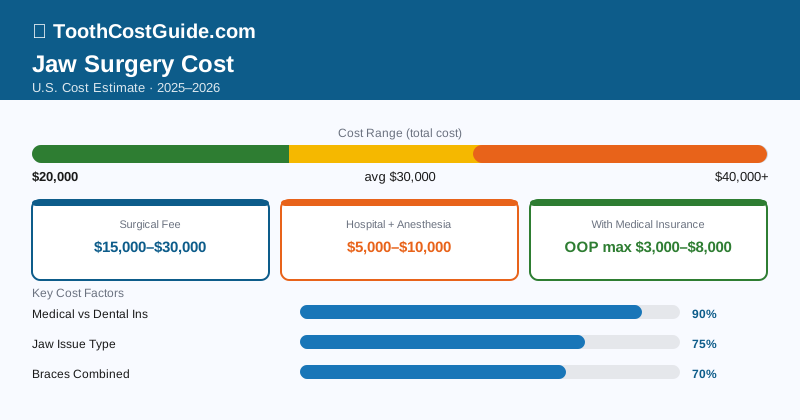
Jaw surgery (orthognathic surgery) costs $20,000–$40,000 for the complete treatment process, including pre-surgical orthodontics, the surgical procedure, and post-surgical orthodontics. The surgery itself — performed by an oral and maxillofacial surgeon (OMFS) — costs $6,000–$15,000 for the surgeon’s fee, with hospital facility fees, anesthesia, and orthodontic treatment adding the remaining costs. When properly documented as medically necessary, medical insurance covers a significant portion of the surgical and hospital costs.
| Cost Component | Cost Range |
|---|---|
| Pre-surgical orthodontics (braces, 12–18 months) | $3,000–$6,000 |
| Oral surgeon fee — single-jaw surgery | $6,000–$10,000 |
| Oral surgeon fee — double-jaw surgery (bimaxillary) | $8,000–$15,000 |
| Hospital facility fee (inpatient) | $5,000–$20,000 |
| Anesthesia fee | $1,500–$4,000 |
| Post-surgical orthodontics (6–12 months) | $1,500–$3,000 |
| Imaging, diagnostic records, planning | $500–$2,500 |
| Total (single-jaw, with insurance) | $4,000–$15,000 out-of-pocket |
| Total (double-jaw, without insurance) | $30,000–$50,000+ |
What Jaw Surgery Treats
Orthognathic surgery corrects skeletal jaw discrepancies — problems with the bones of the upper jaw (maxilla), lower jaw (mandible), or both — that cannot be adequately corrected through orthodontic tooth movement alone.
Conditions treated with jaw surgery:
- Severe overbite (Class II): Lower jaw too far back relative to upper jaw. Surgery advances the lower jaw (mandibular advancement) or sets back the upper jaw
- Severe underbite (Class III): Lower jaw too far forward. Surgery sets back the lower jaw (mandibular setback) or advances the upper jaw
- Open bite: Upper and lower teeth don’t meet when the mouth is closed. Surgery rotates the jaw to close the vertical gap
- Asymmetry: One side of the jaw is significantly longer or shorter than the other
- Cleft palate complications: Jaw correction as part of cleft treatment
- Sleep apnea: Jaw advancement (MMA — maxillomandibular advancement) is one of the most effective surgical treatments for severe obstructive sleep apnea
- Facial trauma or congenital jaw abnormalities
The Jaw Surgery Process
Phase 1 — Pre-surgical orthodontics (12–18 months): Braces are placed to align teeth into their final position within each arch — without trying to compensate for the skeletal discrepancy. This process actually makes the bite look worse before surgery (the dental compensation that was masking the skeletal problem is removed). Pre-surgical braces cost $3,000–$6,000.
Phase 2 — Surgical planning: 3D imaging (CBCT), dental models, and digital surgical planning software are used to precisely plan the amount and direction of jaw movement. This planning phase has become highly sophisticated, with some surgeons using 3D-printed surgical guides. Planning costs: $500–$2,500.
Phase 3 — Surgery (inpatient procedure): Performed under general anesthesia, typically requiring 1–3 nights of hospital stay. The surgeon makes incisions inside the mouth (no external scars), cuts the jaw bone(s), repositions them to the planned position, and stabilizes with titanium plates and screws. Surgery time: 2–6 hours depending on single vs. double jaw.
Recovery: Jaws are not wired shut in modern orthognathic surgery (arch bars may be placed but usually allow jaw opening for jaw exercises within days). Liquid and soft diet for 4–6 weeks. Most patients return to normal activities in 4–6 weeks; full healing of bone takes 6–12 months.
Phase 4 — Post-surgical orthodontics (6–12 months): Fine-tuning of tooth positions after the jaw is in its new location. Braces or aligners are used to finalize occlusion. Cost: $1,500–$3,000.
Jaw surgery must be performed by a board-certified oral and maxillofacial surgeon with specific orthognathic surgery training and volume. Not all OMS surgeons perform jaw repositioning surgery regularly — ask specifically how many orthognathic cases your surgeon performs per year and whether they use digital surgical planning. Volume and specialization matter significantly for outcomes.
Medical Insurance Coverage
Orthognathic surgery is covered by medical insurance (not dental insurance) when documented as medically necessary. The surgical and hospital components are medical procedures, not dental procedures.
What medical insurance covers:
- Surgeon’s fee: After deductible and out-of-pocket max, typically 70–90% of contracted rate
- Hospital facility fee: Covered as inpatient surgical benefit
- Anesthesiologist fee: Covered as surgical anesthesia benefit
- Pre-surgical imaging and planning: Covered as diagnostic benefit
Documentation required for pre-authorization:
- Clinical photographs and X-rays
- Dental models and bite analysis
- Letter from orthodontist describing the treatment plan and medical necessity
- Letter from surgeon describing the surgical plan and medical necessity
- Severity measurements (jaw discrepancy in millimeters)
- Description of functional impairment: difficulty chewing, speech problems, sleep apnea, TMJ dysfunction
What dental insurance covers:
- Pre-surgical and post-surgical orthodontic treatment (under orthodontic benefit, up to lifetime maximum of $1,000–$3,000)
Combined coverage example (double-jaw surgery):
- Total surgical/hospital cost: $25,000
- Medical insurance pays (80% after $5,000 out-of-pocket max): $16,000
- Patient medical out-of-pocket: $5,000–$9,000
- Orthodontic treatment: $5,000
- Dental insurance pays (50%, up to $2,000 lifetime max): $2,000
- Patient orthodontic out-of-pocket: $3,000
- Total patient out-of-pocket: $8,000–$12,000
Pre-authorization from medical insurance is mandatory before proceeding with jaw surgery. Insurance companies require a detailed letter of medical necessity and supporting documentation. Starting surgery without pre-authorization — or being denied and appealing after the fact — is extremely difficult. Ensure your surgeon’s billing team is experienced with orthognathic surgery pre-authorization. This process can take 30–90 days.
When Surgery Is NOT the Right Answer
Surgery should not be pursued for:
- Cosmetic dissatisfaction with the chin or facial appearance when no functional impairment exists
- Cases that can achieve adequate results through dental compensation (orthodontic camouflage)
- Patients under 18 whose jaw growth is not complete (surgery before growth is complete risks relapse as growth continues)
- Patients who are not medically healthy enough for general anesthesia and hospitalization
Orthognathic surgery is not cosmetic jaw augmentation (genioplasty to advance the chin can sometimes be done simultaneously, but the primary surgery addresses functional bone discrepancy).
Financing Options
Medical insurance coordination is the primary financing strategy. Work with your surgeon’s billing team to maximize insurance recovery.
For out-of-pocket balances:
- Hospital payment plans: Hospitals offer 0% interest financing plans for large balances, sometimes over 24–60 months
- Medical credit (CareCredit, Prosper Healthcare Lending): Healthcare-specific financing for large medical expenses
- HSA funds: Hospital surgical expenses are fully HSA eligible
For orthodontic component: Standard dental practice financing — in-house plans, CareCredit, FSA/HSA.
How to Save on Jaw Surgery
Academic medical centers. Hospital-based residency programs with OMFS programs and orthodontic programs frequently manage combined surgical cases at academic medical center rates, which are often lower than private practice rates for the same procedure. Cases are managed by supervised residents.
In-network surgical and hospital choices. Choosing in-network providers can reduce surgical fees by 40–60% compared to out-of-network rates. Always verify that your surgeon, anesthesiologist, and hospital facility are all in-network with your medical insurance.
Appeal denials aggressively. Insurance denials for jaw surgery are common on initial submission. Work with your surgeon’s billing team to file a detailed appeal with clinical photographs, measurements, and functional impairment documentation. Success rates for orthognathic surgery appeals with good documentation are high.
Genioplasty as a standalone (for mild chin asymmetry). For patients whose primary concern is minor chin position without significant jaw discrepancy, a sliding genioplasty (chin repositioning) is simpler than full orthognathic surgery and costs $5,000–$10,000.
Bottom Line
Complete jaw surgery treatment including pre-surgical orthodontics, surgery, and post-surgical orthodontics costs $20,000–$40,000+ before insurance. With proper medical insurance pre-authorization and coverage, patient out-of-pocket cost typically falls in the $5,000–$15,000 range for most cases. Surgery is only appropriate when jaw discrepancy causes functional impairment and cannot be adequately corrected with orthodontic treatment alone. Academic medical center programs and aggressive insurance pre-authorization are the most powerful strategies for managing cost.
Jaw surgery is a major investment but a life-changing procedure for patients with significant skeletal jaw discrepancies. Medical insurance covers the surgical component when properly documented. Plan 2–3 years for the full treatment process. Get pre-authorization before starting, choose in-network providers, and consider academic medical centers for maximum quality at the best total cost.