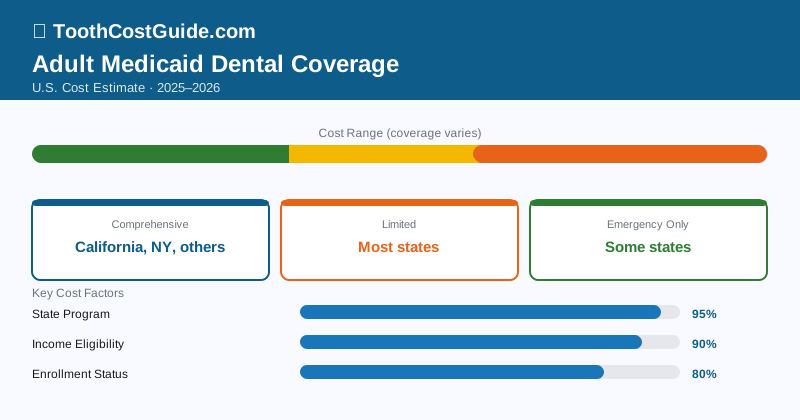
Adult Medicaid dental benefits can save qualifying Americans $200–$5,000+ per year in dental costs, but coverage varies dramatically by state — from zero benefits to comprehensive care including crowns, dentures, and root canals. As of 2025, 34 states plus DC offer at least some adult dental coverage under Medicaid, while 16 states provide emergency-only or no dental benefits.
| Coverage Level | States (examples) | What’s Covered | Patient Cost |
|---|---|---|---|
| Comprehensive | CA, NY, MA, WA, IL | Cleanings, fillings, crowns, dentures, root canals | $0–$3 copay |
| Limited | TX, FL, GA, OH | Cleanings, basic fillings, extractions only | $0–$5 copay |
| Emergency-only | AL, MS, SC | Tooth extractions for pain/infection only | $0–$3 copay |
| No adult dental | ~16 states | Nothing | — |
How It Works
Medicaid is a joint federal-state health insurance program for low-income Americans. While the federal government requires states to cover dental for children (through CHIP), adult dental coverage is optional. States that choose to offer it receive federal matching funds.
When you’re enrolled in Medicaid, you receive a Medicaid ID card and choose (or are assigned to) a managed care plan in most states. That plan has a network of participating dentists. You show your Medicaid card at the dentist, pay any required copay (usually $0–$5), and Medicaid pays the dentist directly.
Annual benefit caps are common. Many states cap adult dental benefits at $500–$2,000 per year. California’s Denti-Cal program has no annual cap for most covered services.
Costs & Savings Details
The savings potential is substantial:
- Comprehensive states (CA, NY, MA): A full year of dental care — two cleanings, exams, X-rays, fillings, and even a crown — can be obtained for $0–$15 in patient copays, versus $1,500–$3,000+ out of pocket without coverage.
- Limited coverage states: Two cleanings and an extraction might cost $0–$10 in copays, saving $300–$600 versus private pay.
- Emergency-only states: An extraction that would cost $150–$350 privately may be covered at $0–$3 copay.
States with the best adult Medicaid dental benefits (2025):
- California (Denti-Cal): Comprehensive, including crowns and dentures
- New York: Comprehensive with $1,000–$1,500 annual cap
- Massachusetts: Comprehensive, including orthodontia in some cases
- Washington: Comprehensive with generous caps
- Illinois: Comprehensive, restored full benefits in 2018
- Oregon: Comprehensive under Oregon Health Plan
- Michigan: Comprehensive coverage restored in recent years
States with emergency-only or no adult dental: Alabama, Mississippi, South Carolina, Wyoming, Utah (limited), and others. Check your state’s Medicaid agency website for current status, as states periodically expand benefits.
Eligibility / Who Qualifies
Income limits (2025 federal poverty level guidelines):
- Most Medicaid expansion states: Adults earning up to 138% FPL (~$20,120/year for an individual, ~$41,400 for a family of four)
- Non-expansion states: Much lower limits, often 18–50% FPL, and typically limited to parents, pregnant women, or people with disabilities
- 41 states + DC have expanded Medicaid; 10 states have not (check healthcare.gov for current status)
Other qualifying categories:
- Pregnant women (dental often covered more broadly during pregnancy)
- Adults with disabilities receiving SSI or SSDI
- Adults receiving Supplemental Security Income (SSI)
- Foster care youth up to age 26 in some states
Not eligible for Medicaid? Check if you qualify for CHIP (if you have children under 19), marketplace plans with subsidies, or your state’s separate CHIP for adults (CHIP look-alikes exist in some states).
Pros and Cons
Pros
- Free or nearly free dental care for qualifying enrollees
- No premiums in most cases
- Covers preventive and sometimes comprehensive care
- Children universally covered through CHIP/Medicaid
- Can be enrolled year-round (no open enrollment period)
Cons
- Many states have limited or no adult dental coverage
- Annual benefit caps can be restrictive ($500–$1,500 in many states)
- Not all dentists accept Medicaid — network can be limited
- Prior authorization required for major procedures (crowns, dentures) in most states
- Benefit levels can change with state budgets
Medicaid dental networks are often thin. Before assuming care is available, search your state’s Medicaid provider directory for dentists near you who are currently accepting new Medicaid patients. Providers can drop out of networks, so verify before your appointment.
Step-by-Step Guide
Check your state’s coverage: Visit your state’s Medicaid agency website (search “[State] Medicaid dental adult benefits 2025”) or call 1-800-MEDICARE (1-800-633-4227) to be connected with your state’s Medicaid office.
Confirm eligibility: Use the eligibility screening tool at healthcare.gov or benefits.gov. Enter your state, household size, and income to see if you qualify.
Apply for Medicaid: Apply online at your state’s Medicaid portal, by phone, by mail, or in person at your local Department of Social Services. The federal portal healthcare.gov also accepts applications and forwards them to your state.
Document preparation: Gather proof of identity (government ID), proof of income (pay stubs, tax return, or unemployment benefit letter), proof of residency (utility bill or lease), and Social Security numbers for all household members.
Enroll in a plan: In most states you’ll be enrolled in a Medicaid managed care organization (MCO). You may be able to choose your plan or request a change if your preferred dentist is not in your initial plan’s network.
Find a participating dentist: Use your MCO’s provider directory or your state Medicaid website’s dentist locator. Call ahead to confirm the dentist is accepting new Medicaid patients.
Schedule and attend: Bring your Medicaid ID card to every appointment. Know your plan’s covered services and any prior authorization requirements for major work.
If your state has limited adult Medicaid dental, check whether you live near a Federally Qualified Health Center (FQHC). FQHCs accept Medicaid AND offer sliding-scale fees for services Medicaid doesn’t cover, effectively filling the gap. Find one at findahealthcenter.hrsa.gov.
Bottom Line
Medicaid dental can be one of the most valuable financial resources available to low-income Americans — but you have to live in a state that offers it and successfully enroll. Start by checking your state’s current adult dental coverage at your state Medicaid agency’s website. If you qualify, enrollment is straightforward and can be done online in most states. Even limited coverage for cleanings and extractions can save hundreds of dollars annually, and comprehensive-state enrollees can save thousands.