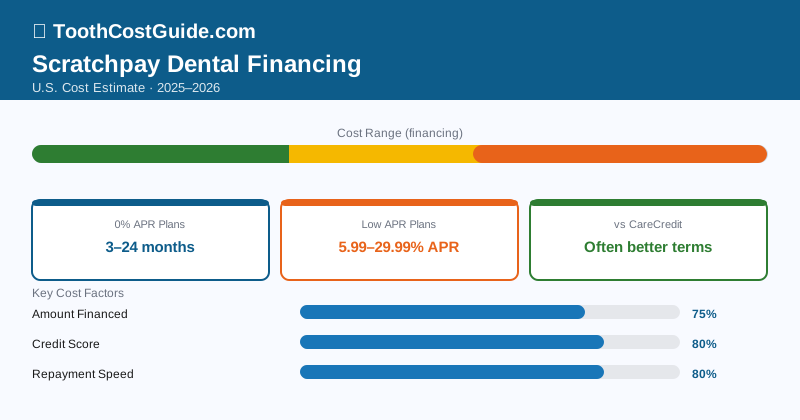
Scratchpay is a dental financing platform that offers true 0% APR plans (no deferred interest) for qualifying patients, making it a more transparent alternative to CareCredit’s deferred-interest model — potentially saving patients $300–$900 in surprise interest charges on large dental bills. Understanding the difference between these two platforms could save or cost you hundreds.
| Feature | Scratchpay | CareCredit |
|---|---|---|
| APR range | 0–29.99% | 0% deferred or 26.99–29.99% standard |
| Promotional 0% period | 3–24 months (true 0%) | 6–24 months (deferred interest) |
| Credit check type | Soft pull (no credit score impact) | Hard pull (affects credit score) |
| Minimum loan amount | $200 | $200 |
| Maximum loan amount | $10,000 | No stated maximum |
| Application time | ~2 minutes online | ~5 minutes online |
| Monthly fee | $0 | $0 |
| Late payment fee | Up to $35 | Up to $40 |
| Where accepted | ~10,000+ dental providers | ~250,000+ healthcare providers |
How It Works
Scratchpay is a fintech platform partnered with Celtic Bank. When you apply, a soft credit check is performed (no impact on your credit score). Based on your credit profile, you’re offered one or more plan options. These may include:
- 0% APR plans: True 0% — no deferred interest. If you pay off the balance within the promotional period, you owe exactly what you borrowed.
- Low APR plans: For patients who don’t qualify for 0%, plans with 5.99–29.99% APR over 12–48 months are offered.
Apply at scratchpay.com or through your dental office’s patient portal. Approval takes about 2 minutes. You receive a plan offer immediately and can accept digitally.
CareCredit works similarly but with key differences. CareCredit uses a hard credit pull, which temporarily lowers your credit score by 5–10 points. Most promotional offers are “deferred interest” — if any balance remains at the promotional period’s end, all the interest that would have accrued from day one is charged retroactively at the standard APR (26.99–29.99%).
Costs & Savings Details
The deferred interest danger with CareCredit (example):
You charge a $3,500 crown and root canal to CareCredit’s 18-month promotional period.
- Monthly payment to clear in 18 months: ~$194
- You make 17 payments ($3,298) and miss the final payment of $202
- CareCredit charges retroactive interest: ~$1,400 (18 months of 26.99% APR on $3,500)
- You owe $1,600 instead of $202
With Scratchpay’s true 0% plan:
- Same $3,500 balance over 18 months
- You pay $194/month for 18 months and owe nothing extra
- Even if you pay late, you only owe the remaining balance + late fee (~$35)
For patients who receive APR-based offers from Scratchpay: A 12-month loan of $2,000 at 14.99% APR costs about $180/month with roughly $155 in total interest — less expensive than a credit card at 25% APR ($184/month, $210 in interest).
Eligibility / Who Qualifies
Scratchpay:
- US residents 18 or older
- Valid Social Security number
- Active checking account or debit card
- Soft credit check — patients with fair to good credit (580+) often qualify for some offer
- Patients with limited credit history may receive smaller loan amounts
CareCredit:
- US residents 18 or older
- Hard credit pull required
- Recommended credit score: 620+ for approval; 660+ for better promotional terms
- Patients with poor credit may be denied
Both platforms: Available only when you use a participating dental provider. Ask your dental office which platforms they accept before applying.
Pros and Cons
Scratchpay Pros
- Soft credit check (no score impact at application)
- True 0% interest — no deferred interest trap
- Fast, fully digital approval process
- Transparent terms — no surprise interest charges
Scratchpay Cons
- Smaller provider network than CareCredit
- Maximum $10,000 limit (less than CareCredit for large procedures)
- Not all applicants qualify for 0% — APR can reach 29.99%
- Relatively new platform — less brand recognition
CareCredit Pros
- Accepted at 250,000+ healthcare providers including most dental offices
- Longer promotional 0% periods available (up to 24 months)
- Established brand with many patients already having accounts
- No monthly fee
CareCredit Cons
- Hard credit check impacts credit score
- Deferred interest model is consumer-unfavorable
- Standard APR of 26.99–29.99% is high
- Many patients are surprised by retroactive interest charges
If CareCredit is your only financing option, treat the promotional period end date as a hard deadline. Set a calendar alarm 60 days before the end and make sure the full balance will be zero before that date. Carrying even $1 of balance to the final day triggers the retroactive interest charge.
Step-by-Step Guide
Check if your dental office accepts Scratchpay: Visit scratchpay.com and click “Find a Provider” or ask your dental office directly. If they don’t accept Scratchpay, ask which financing options they do offer.
Apply for Scratchpay first: Since it uses a soft credit pull, applying doesn’t cost you anything in terms of credit score impact. Visit scratchpay.com, enter the treatment amount, and complete the application (takes ~2 minutes).
Review all offers: Scratchpay may show multiple plan options. Compare the 0% plan (short term, higher monthly payment) versus APR-based plans (longer term, lower monthly payment but with interest).
Calculate total cost: Multiply monthly payment by number of months to see total repayment. Compare to the 0% plan’s total (which equals the original amount borrowed).
If applying to CareCredit: Accept the hard credit pull, apply at carecredit.com, and if approved, commit to paying the full balance before the promotional period ends. Calculate the exact monthly payment needed: balance ÷ number of months = required monthly payment.
Set up autopay: Both Scratchpay and CareCredit allow autopay. Setting this up eliminates missed payments and protects against accidentally triggering penalty interest.
Compare to personal loan alternatives: For amounts over $5,000 or longer terms, check a credit union or LightStream for personal loan rates. Credit union personal loans often come in at 8–13% APR — significantly cheaper than high APR financing for large dental bills.
Apply to Scratchpay before your dental appointment. You don’t need to have the treatment yet — knowing your approved amount in advance lets you have a clear conversation with your dentist about what you can afford and helps you get started on treatment faster without awkward checkout conversations.
Bottom Line
For most dental patients needing financing, Scratchpay’s true 0% interest model is more transparent and consumer-friendly than CareCredit’s deferred-interest approach. If your dental office accepts Scratchpay, apply there first — a soft credit pull gives you an offer with no commitment and no credit score impact. If only CareCredit is available, use it strategically by paying the full balance well before the promotional period ends. For very large amounts (implants, full arch restoration over $10,000), compare personal loan rates from credit unions before committing to either dental financing platform.