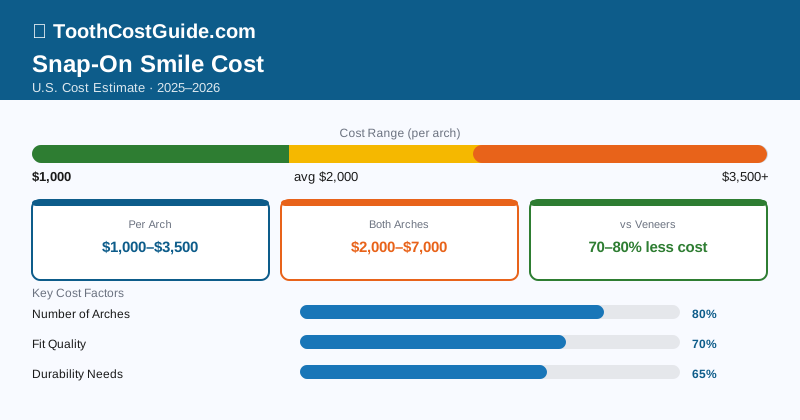
Snap-On Smile costs $1,000–$3,500 for a single arch (upper or lower) in the United States, with most patients paying $1,200–$2,000 per arch through a dentist. This removable dental appliance snaps over your existing teeth using a thin resin shell custom-fitted to your bite, masking the appearance of stained, chipped, gapped, or misshapen teeth without drilling, anesthesia, or permanent alteration to your teeth. It’s one of the few cosmetic dental options that is entirely reversible — and one of the most misunderstood in terms of what it can realistically deliver.
Snap-On Smile Costs by Option
| Product / Scenario | Cost |
|---|---|
| Snap-On Smile (dentist, single arch) | $1,000–$3,500 |
| Snap-On Smile (dentist, both arches) | $2,000–$5,000 |
| Generic removable veneers (online, no dentist) | $100–$500 |
| Instant smile direct-mail resin appliances | $20–$150 |
| Replacement Snap-On Smile appliance | $800–$2,000 |
| Traditional porcelain veneers (for comparison) | $900–$2,500 per tooth |
| Composite bonding (for comparison) | $200–$600 per tooth |
What Affects the Cost of Snap-On Smile
Dentist fees and lab fees. Snap-On Smile is a proprietary product from Den-Mat Corporation, requiring a licensed dentist to take impressions, select shade and tooth shape with the patient, and submit the case to the Den-Mat laboratory. The lab fabricates the appliance from a high-strength dental resin. The dentist marks up the lab fee and bills for their chair time — typically two appointments (impression + fitting). Dentist fees account for most of the $1,000–$3,500 range, while the lab component runs $400–$700.
Upper arch only vs. upper and lower. Most patients have Snap-On Smile made for the upper arch only, since upper teeth are what show most when smiling. Upper arch only: $1,000–$3,500. Both arches: $2,000–$5,000. Ask your dentist whether both arches are clinically necessary — for cosmetic improvement alone, the upper arch usually suffices.
Shade and design complexity. Snap-On Smile comes in a range of shades and tooth shapes — from natural to dramatically bright white. More complex designs with multiple shade gradations or specific customizations may have higher lab fees. Standard shade selections are within the base price.
Geographic location and dentist type. As with all dental procedures, fees vary by market. Snap-On Smile through a cosmetic dentist in a major city may cost $2,500–$3,500. A general dentist in a smaller market may offer it for $1,000–$1,800 for the same lab-fabricated product. The appliance itself is the same — the difference is purely the dentist’s professional fee.
Snap-On Smile is not a substitute for veneers, bonding, or other restorative work. It sits over existing teeth like a thin resin shell — making teeth look better while wearing it — but it does not fix underlying structural problems and must be removed for eating most foods. Before spending $1,000–$3,500, understand exactly what it can and cannot do for your specific situation.
What Snap-On Smile Can and Cannot Do
What it can do well: Cover the appearance of mildly stained, yellowed, or discolored teeth. Mask the look of small gaps, slightly crooked teeth, or minor chips. Provide a cosmetic improvement while a patient saves for more permanent treatment. Serve as a long-lasting temporary cosmetic appliance for events, photos, or social situations.
What it cannot do: Fix a broken tooth that needs a crown. Replace missing teeth as a structural solution. Be worn while eating anything hard, sticky, or chewy — it must be removed or restricted to soft foods. Last as long as veneers — typical lifespan is 3–5 years before chipping or discoloration. Provide the same aesthetic refinement as custom porcelain veneers, which are bonded to teeth and individually sculpted for natural appearance.
Durability reality check. The resin material used in Snap-On Smile is more durable than cheap online alternatives but less durable than porcelain. Most appliances last 3–5 years before showing wear, discoloration, or fracture — especially for patients who wear them frequently. Replacement costs $800–$2,000. Over a 10-year period, you may spend $2,000–$6,000 on multiple Snap-On Smile appliances versus $1,800–$5,000 for traditional veneers that can last 10–20 years.
Thickness and speech. Snap-On Smile adds 0.5–1.5mm to the front of teeth. Some patients notice a minor lisp or changes in speech, particularly in the first weeks of wear. Most patients adapt, but this is worth knowing before committing.
With vs. Without Dental Insurance
Snap-On Smile is a cosmetic dental appliance and is not covered by dental insurance. There are no exceptions for this — insurance uniformly excludes cosmetic appliances that do not restore function or replace missing teeth.
Without insurance: All costs are out of pocket — $1,000–$3,500 per arch. This is the norm for all Snap-On Smile purchases.
HSA/FSA eligibility: This is an important gray area. The IRS considers dental expenses for purely cosmetic purposes ineligible for HSA/FSA reimbursement. However, if the appliance is prescribed by a dentist as part of a treatment plan addressing a functional concern (for example, a temporary cosmetic solution while waiting for restorative work that restores function), some HSA administrators may allow the expense. This is not guaranteed — consult your plan administrator before using pre-tax funds for Snap-On Smile.
Comparison to alternatives: For the $1,000–$3,500 cost of Snap-On Smile, a patient could alternatively invest in: 2–8 teeth of composite bonding ($200–$600 per tooth, permanent), professional whitening ($300–$800, which addresses staining without covering teeth), or 1–2 porcelain veneers ($900–$2,500 each, on the highest-impact teeth). These alternatives are worth evaluating before choosing a removable appliance.
Before purchasing Snap-On Smile, ask your dentist: “What permanent treatment would address my concerns, and how much would it cost?” Many patients find that targeted composite bonding on 2–3 key teeth costs similar to or less than Snap-On Smile and delivers a permanent rather than removable result. Snap-On Smile is most appropriate when permanent treatment is cost-prohibitive or when temporary cosmetic improvement is the genuine goal.
How to Save Money on Snap-On Smile
Avoid online “snap on veneers” without a dentist. Dozens of online companies (PressOn Veneers, Instasmile, Secret Veneers, etc.) offer mail-in impression kits and plastic veneer sets for $100–$500. These are made from much thinner, less durable resin than the professionally fabricated Snap-On Smile and have no bite registration — meaning they may not fit your bite properly and can cause jaw problems or tooth wear if worn regularly. The price is tempting, but the comparison to professional appliances is misleading.
Shop dentist fees. The lab fee for Snap-On Smile is fixed (Den-Mat charges all dentists the same), but the professional fee varies. Call several dentists in your area and ask specifically what they charge for Snap-On Smile upper arch only. You may find $400–$800 in variation between practices in the same city.
Upper arch only. If your goal is improving your smile in photos and social situations, you likely only need the upper arch. Upper-only pricing ($1,000–$2,500) is meaningfully less than both arches ($2,000–$5,000).
Ask about payment plans. Many cosmetic dental practices offering Snap-On Smile provide in-house payment plans or partner with CareCredit. Given the cosmetic nature of the purchase, cash-pay discounts are sometimes available — ask directly.
Dental schools. Dental schools that offer Snap-On Smile (not all do) charge the lab fee plus a reduced professional fee, potentially saving $300–$600 compared to private practice pricing. Call the dental school prosthodontics or cosmetic clinic directly to ask.
Financing Options
At $1,000–$3,500 per arch, Snap-On Smile falls in the range where financing is available but the amounts are manageable for many patients.
CareCredit. Accepted at most dental offices. For amounts of $1,000–$3,500, a 6–12 month 0% promotional period is typically available. Monthly payments of $100–$300 clear the balance within the promotional window for most patients.
In-office payment plans. Cosmetic dental practices often structure internal payment plans for appliances like Snap-On Smile. Three to six monthly installments at 0% is common when asked.
Lay-away approach. Unlike surgery, Snap-On Smile can be deferred until fully paid. Some dentists will collect a deposit, hold your impressions and design on file, and proceed with fabrication once the balance is paid. Ask whether this is possible if upfront payment is a barrier.
Dental savings plans. Membership plans at dental offices typically discount cosmetic procedures by 15–20%. If you’re a member, your $2,000 Snap-On Smile becomes $1,600–$1,700 — a meaningful saving.
Bottom Line
Snap-On Smile is a legitimate cosmetic dental option at $1,000–$3,500 per arch — provided you understand what you’re buying. It’s a professionally fabricated, custom-fit removable appliance that improves smile appearance while worn. It’s not veneers, it’s not permanent, and it doesn’t address underlying dental issues.
It makes the most sense for patients who want a cosmetic improvement while saving for permanent treatment, those who need a temporary solution for an event or life transition, or patients for whom permanent veneers are financially out of reach. For patients who want to address a few specific teeth permanently, targeted bonding at $200–$600 per tooth is often a better value.
Always get a full dental evaluation before committing to any cosmetic appliance — an undetected cavity, cracked tooth, or gum disease issue makes the appliance at best a waste of money and at worst a problem mask.
Dental cost estimates in this guide reflect U.S. national averages for 2024–2025 and may vary significantly by geographic region, provider type, and individual treatment needs. Snap-On Smile is a cosmetic appliance, not a medical device or substitute for dental treatment. Always have a complete dental examination before any cosmetic procedure to ensure underlying dental health issues are addressed first.