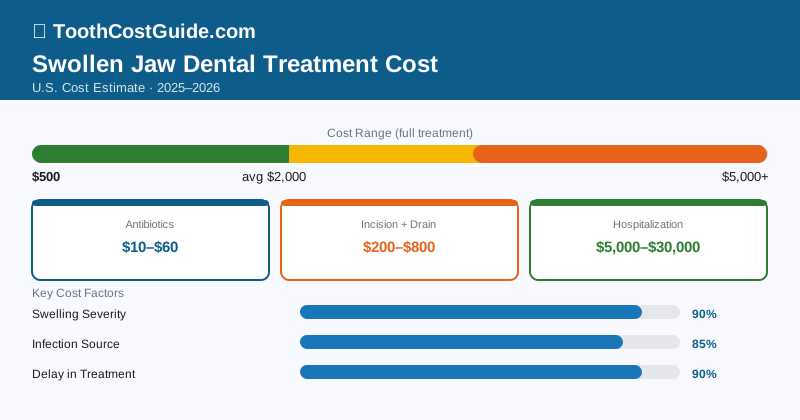
A swollen jaw from a dental cause requires prompt treatment — delays can turn a manageable infection into a life-threatening emergency. Most cases cost $500–$3,000 to treat at the dental level. If the infection has spread to the deep spaces of the neck and jaw, emergency hospitalization can cost $15,000–$50,000 or more. The cause of the swelling determines both the urgency and the cost.
| Severity & Cause | Treatment | Cost (No Insurance) |
|---|---|---|
| Dental abscess (localized) | Root canal or extraction + antibiotics | $700–$2,000 |
| Pericoronitis (wisdom tooth) | Cleaning, antibiotics, or extraction | $150–$800 |
| Gum abscess (periodontal) | Scaling, drainage, antibiotics | $300–$1,500 |
| Cellulitis (spreading soft tissue) | ER + IV antibiotics | $3,000–$15,000 |
| Ludwig’s angina (floor of mouth) | ICU, surgery, airway management | $25,000–$100,000+ |
| Broken jaw (trauma-related) | Surgery, wiring | $5,000–$30,000 |
| Emergency exam + X-rays/CT | Diagnosis | $100–$1,500 |
What Affects the Cost
Cause of the swelling. Dental swelling has multiple causes with very different cost profiles. A periapical abscess from a single infected tooth costs $700–$2,000 to treat. Pericoronitis (infection around an erupting or impacted wisdom tooth) may resolve with antibiotics and irrigation for $150–$300, or require extraction at $300–$800. Spreading cellulitis or Ludwig’s angina are surgical emergencies.
How far the infection has spread. Dental infections spread along fascial planes (tissue planes in the jaw and neck). Early treatment when infection is contained to the tooth socket is cheapest. Once infection crosses into the submandibular space, infratemporal space, or floor of the mouth, surgical drainage under general anesthesia in a hospital becomes necessary.
Whether hospitalization is required. Mild localized swelling is treated in a dental office for hundreds of dollars. Swelling that compromises swallowing or breathing requires emergency hospitalization — ICU care for Ludwig’s angina can run $50,000–$100,000 for a prolonged stay with airway management.
Imaging needed. A dental X-ray ($25–$150) is enough for a simple abscess. A panoramic X-ray ($100–$250) shows more of the jaw. A CT scan of the face and neck ($500–$2,000 with contrast) is required when the extent of a spreading infection needs to be mapped — common in ER settings for significant jaw swelling.
Oral surgery vs. general dentist. Severe infections, wisdom tooth extractions, and cases requiring surgical drainage are typically handled by oral and maxillofacial surgeons (OMS), who charge 20–40% more than general dentists for comparable procedures.
Treatment Options & Costs
Antibiotics + dental treatment ($700–$2,000): For most localized dental infections causing jaw swelling, the treatment is antibiotics (amoxicillin or clindamycin, $10–$60 with GoodRx) plus definitive dental care — root canal ($700–$1,500) or extraction ($150–$600). Swelling typically begins to subside within 48–72 hours of starting antibiotics.
Incision and drainage ($150–$400): Large fluctuant abscesses that are “pointing” (coming to a head beneath the skin or gum) are drained by the dentist or oral surgeon. The pus is evacuated, a small drain may be placed, and the area is irrigated. Provides rapid relief and speeds resolution.
Wisdom tooth extraction ($300–$800): If swelling is related to an impacted or partially erupted third molar with pericoronitis, extraction eliminates the source. Simple erupted wisdom tooth extraction: $150–$350. Impacted wisdom tooth requiring surgical extraction: $300–$600 per tooth. Oral surgeon fees are at the higher end.
Emergency room treatment ($1,500–$5,000+): When dental offices are closed or swelling is severe, the ER provides IV antibiotics, imaging, pain management, and airway assessment. Most ERs cannot perform root canals or extractions — they stabilize the patient and refer to a dentist or oral surgeon. ER costs for a dental infection visit: $1,500–$5,000 for an uncomplicated case; far more if admission is required.
Surgical hospitalization ($10,000–$100,000+): Deep space neck infections require surgical exploration and drainage under general anesthesia, often followed by ICU monitoring and 5–10 days of IV antibiotics. This is the catastrophic end of untreated dental infections.
With vs. Without Insurance
Dental insurance covers the dental components:
- Root canal: 40–60%
- Extraction: 75–90% for simple; 50–75% for surgical
- Emergency exam: 80–100%
- Antibiotics: Often covered under pharmacy benefits ($0–$15)
Medical insurance covers hospital and ER components:
- ER visit: Subject to ER copay ($150–$500) plus deductible and coinsurance
- Hospitalization: Subject to annual deductible ($1,000–$6,000) and coinsurance (20%)
- CT scan: Covered under major medical; typical patient share $200–$800
Coordination of benefits: When treatment spans dental and medical care, file with both insurers. ER visits for dental pain are medical expenses; the root canal performed later is dental.
What To Do
- Assess severity immediately. Mild gum puffiness near a tooth is less urgent. Visible facial swelling that’s grown over hours, or swelling beneath the chin/neck, requires emergency care.
- Call a dentist first if the office is open and swelling is limited to the jaw near a tooth.
- Go to an ER if swelling is rapidly enlarging, if you have difficulty opening your mouth, swallowing, or breathing, or if you have fever above 102°F with swelling.
- Start warm saltwater rinses hourly — this won’t cure infection but can help draw surface abscesses.
- Take OTC ibuprofen for pain and to reduce inflammation.
- Do not apply heat to a spreading infection — heat can accelerate bacterial spread through tissues.
How to Save Money
Act early. A localized abscess treated at a dentist for $1,000–$1,500 is exponentially cheaper than one that spreads to the neck requiring hospitalization at $30,000+.
Dental school oral surgery clinics. For wisdom tooth extractions and complex oral surgery, dental school OMS clinics charge 40–60% less than private practice.
GoodRx for antibiotics. A 7-day course of amoxicillin 500 mg costs $4–$10 with GoodRx. Clindamycin (for penicillin-allergic patients) costs $15–$30.
Community health centers. FQHCs provide emergency dental care on sliding scale fees. For patients below 200% of poverty level, care may be free or nearly free.
Jaw swelling that spreads toward the neck, causes difficulty breathing or swallowing, or causes your neck to feel stiff or board-like is a life-threatening emergency. Ludwig’s angina can obstruct the airway within hours. Call 911 immediately. Do not drive yourself to the hospital if swallowing or breathing is compromised.
Bottom Line
Swollen jaw treatment from a dental cause costs $500–$3,000 at the dental office level. The infection source — usually an abscessed tooth or impacted wisdom tooth — must be eliminated with root canal or extraction. If infection has spread beyond the jaw to deep neck spaces, hospital costs escalate to $15,000–$100,000. Speed of treatment is the greatest cost-control factor. Act the same day you notice meaningful jaw swelling.