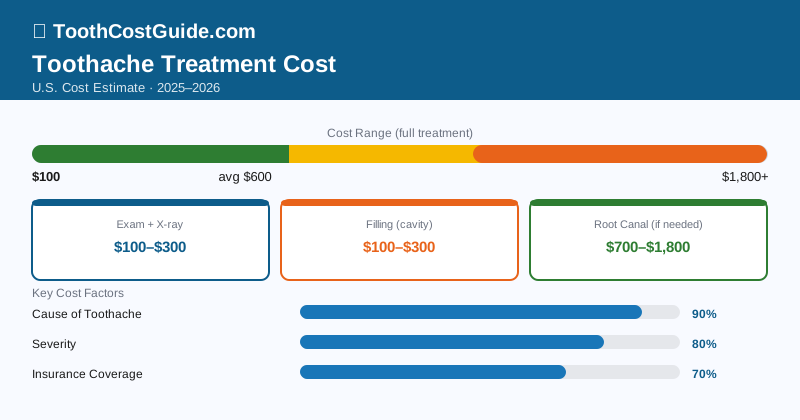
A toothache can cost $100–$500 for minor causes like a cavity or lost filling, or $700–$1,500+ if the pain signals an infected root requiring a root canal. The total you’ll pay depends entirely on what’s causing the pain — which only a dentist can diagnose with an exam and X-rays. Skipping diagnosis and hoping the pain goes away is rarely a money-saving strategy; untreated dental infections can become dangerous and far more expensive.
| Cause of Toothache | Treatment | Typical Cost (No Insurance) |
|---|---|---|
| Cavity (small to medium) | Filling | $100–$300 |
| Cracked or chipped tooth | Bonding or crown | $200–$1,500 |
| Lost or broken filling | Replacement filling | $100–$300 |
| Pulpitis (inflamed nerve) | Root canal + crown | $1,200–$2,500 |
| Dental abscess | Root canal or extraction | $700–$3,000 |
| Impacted wisdom tooth | Extraction | $300–$800 |
| Gum disease (periodontitis) | Deep cleaning | $200–$400 per quadrant |
| Sinus pressure (referred pain) | No dental treatment needed | $0–$200 (urgent care) |
What Affects the Cost of Toothache Treatment
The underlying cause. Toothache is a symptom, not a diagnosis. A cavity causing a mild ache is treated with a $100–$300 filling. An abscess causing throbbing pain that keeps you awake requires root canal therapy ($700–$1,500) plus a crown ($1,000–$1,800) — a total of $1,700–$3,300 at one tooth. Identifying the cause early, when it’s still a cavity, is far cheaper than waiting until it progresses to an infection.
How long you’ve waited. Early decay is treated with a filling. Decay that reaches the pulp requires a root canal. Infection that spreads to the jawbone may need surgical intervention. Every month of delay can push your treatment into the next — more expensive — category.
Emergency vs. scheduled appointment. If you call a dental office in pain and get seen the same day, you may pay an emergency examination fee of $50–$150 on top of treatment costs. After-hours or weekend care often carries surcharges of $100–$300.
Your location and provider. Dentists in major metropolitan areas like New York City, San Francisco, or Boston charge 30–50% more than rural or Midwestern practices for identical procedures. A root canal that costs $900 in rural Ohio might run $1,400 in Manhattan.
Treatment Options & Costs
Dental exam and X-rays ($75–$200): Before any treatment, a dentist needs to determine the cause. Expect a comprehensive or limited emergency exam ($50–$150) plus one or more X-rays ($25–$75 each, or $100–$200 for a full-mouth series). These diagnostic costs are separate from treatment.
Filling ($100–$300): If the cause is a cavity that hasn’t reached the pulp, a composite (tooth-colored) filling resolves the pain and stops decay. This is the best-case scenario for cost.
Root canal therapy ($700–$1,500): When the pulp (the nerve and blood supply inside the tooth) is infected or irreversibly inflamed, a root canal removes the tissue, cleans the canal, and seals it. Front teeth cost $700–$900; molars cost $1,000–$1,500. A crown ($1,000–$1,800) is almost always recommended afterward to protect the treated tooth.
Tooth extraction ($150–$600): If the tooth is too damaged to save or the patient can’t afford a root canal, extraction is the alternative. A simple extraction runs $150–$300; a surgical extraction (broken tooth, impacted tooth) runs $300–$600. The gap left behind will eventually need a bridge ($3,000–$5,000) or implant ($3,500–$6,000) to prevent neighboring teeth from shifting.
Antibiotics ($10–$60 with prescription): Antibiotics do not cure a dental infection — they only temporarily reduce the bacterial load. They’re often prescribed to manage spreading infection before definitive treatment, not as a standalone fix.
With vs. Without Insurance
Toothache treatment spans multiple ADA procedure codes with different coverage levels:
- Exam and X-rays: Usually covered at 80–100% under preventive/diagnostic benefits; minimal out-of-pocket
- Fillings (basic restorative): Covered at 70–90% by most PPO plans after deductible
- Root canal (major restorative): Covered at 40–60% by most plans; patient pays 40–60% of the fee up to the annual maximum
- Crowns: Covered at 40–60%; often has a waiting period of 6–12 months on new plans
- Extraction: Covered at 75–90% for basic extractions; 50–75% for surgical
Real-world example with insurance:
- Root canal on molar: $1,200 dentist fee
- Insurance pays 50% = $600
- Patient pays: $600 (or $650–$700 if annual deductible not yet met)
Without insurance: The same root canal + crown totaling $2,500–$3,300 would be fully out of pocket, though fee negotiation, dental schools, and discount plans can reduce this significantly.
What To Do When You Have a Toothache
- Call a dentist the same day for any toothache with swelling, fever, or pain that wakes you at night — these are signs of infection that can spread.
- Manage pain temporarily with OTC ibuprofen (400–600 mg every 6 hours for adults) or acetaminophen. Ibuprofen reduces inflammation better for dental pain. Clove oil (eugenol) applied topically can numb the area briefly.
- Don’t ignore it hoping it resolves. An infected tooth that “stops hurting” may mean the nerve has died — the infection is still there and spreading.
- Get X-rays. You cannot self-diagnose the cause of a toothache. Don’t let a dentist treat without imaging.
- Ask for the treatment plan in writing before agreeing to major work like a root canal.
How to Save Money on Toothache Treatment
Dental school clinics: Root canals at dental school clinics cost $300–$600 — less than half the private-practice rate. Treatment takes longer but is supervised by experienced faculty. Search for “dental school clinic near me” or visit the ADEA website for a list.
Dental discount plans: Membership plans ($80–$150/year) offer negotiated rates — root canals for $500–$700, crowns for $600–$900. Worth the cost if you’re uninsured and need significant work.
Ask about tooth extraction vs. root canal. An extraction costs $150–$300 versus $1,700–$3,300 for root canal plus crown. If you can’t afford the root canal, extraction avoids the immediate financial crisis — but budget for eventual tooth replacement.
Community health centers: Federally Qualified Health Centers (FQHCs) offer dental care on a sliding-scale fee based on income. Call 1-800-275-4772 or search at findahealthcenter.hrsa.gov.
A toothache with facial swelling, fever above 101°F, difficulty swallowing, or swelling extending to the neck or eye is a medical emergency. Go to the emergency room immediately — dental infections can spread to the airway and become life-threatening within hours.
Bottom Line
Toothache treatment costs $100–$300 for a simple filling and $1,700–$3,300 for a root canal plus crown. The sooner you get treated, the cheaper it is. With dental insurance, most toothache-related treatment costs $100–$700 out of pocket depending on what’s needed. Without insurance, dental schools and discount plans are your best cost-reduction tools. Never ignore a toothache with swelling or fever — those require emergency care regardless of cost.