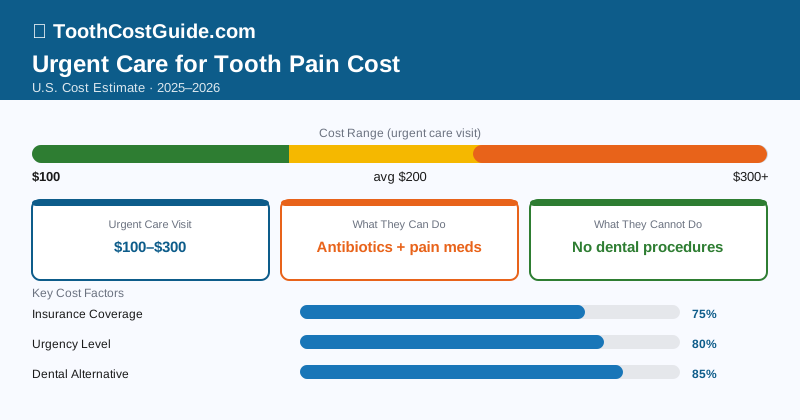
Going to urgent care for tooth pain costs $100–$300 for the visit, not including medications. Urgent care centers can prescribe antibiotics and pain medication, but they cannot fill cavities, perform root canals, or extract teeth. An urgent care visit is a bridge solution — it manages pain and infection temporarily until you can see a dentist. For most dental emergencies, urgent care is appropriate when it’s the weekend, no dentist is available, and you need antibiotics or prescription pain relief.
| Service | Cost Without Insurance | Cost With Insurance |
|---|---|---|
| Urgent care visit (base fee) | $100–$200 | $20–$75 copay |
| X-ray at urgent care (if taken) | $75–$200 | Covered/low copay |
| Antibiotic prescription (amoxicillin) | $4–$60 | $0–$20 with Rx coverage |
| Pain medication prescription (OTC strength) | $10–$30 | $0–$15 with Rx coverage |
| Follow-up dentist visit (still required) | $100–$300+ | Per dental plan |
What Affects the Cost
Urgent care facility type. Retail health clinics (MinuteClinic, CVS Health, Walgreens Health) generally charge $99–$150 for a basic visit. Standalone urgent care centers charge $130–$250. Hospital-affiliated urgent care can run $200–$400. All are significantly cheaper than a hospital ER.
Insurance coverage. Medical insurance typically covers urgent care visits with a copay of $20–$75. Unlike dental insurance, medical insurance doesn’t cover the root cause treatment (filling, root canal) that you’ll still need from a dentist.
Medications needed. A standard 7-day amoxicillin course costs $4–$15 with GoodRx. Prescription-strength ibuprofen or a short course of narcotic pain medication costs $10–$40. All are covered or low-cost with pharmacy insurance.
Whether imaging is taken. Urgent care centers are not equipped for dental X-rays. They may take a general face/jaw X-ray if a fracture is suspected, which costs $75–$200. Dental diagnosis and dental X-rays require a dentist.
Treatment Options & Costs
Antibiotics prescription ($10–$60 with GoodRx): For suspected dental infection, urgent care providers commonly prescribe amoxicillin 500 mg three times daily for 7–10 days, or clindamycin 300 mg three times daily for penicillin-allergic patients. These manage the infection temporarily but don’t cure it — the tooth source must still be treated by a dentist.
Pain management ($10–$40): Prescription-strength ibuprofen (800 mg), prescription acetaminophen with codeine (Tylenol #3), or a brief course of opioid pain medication may be prescribed. Opioid prescribing for dental pain has decreased significantly at urgent care due to new prescribing guidelines, but providers may offer non-opioid prescription pain management.
Referral to dentist or ER: Urgent care providers assess whether your situation requires immediate dental or emergency room care and can document the referral. If you have signs of spreading infection (facial swelling, difficulty swallowing), they’ll send you directly to the ER.
What urgent care cannot do:
- Perform tooth extractions
- Do root canals
- Place fillings or crowns
- Take diagnostic dental X-rays
- Drain deep dental abscesses
- Provide definitive dental treatment of any kind
With vs. Without Insurance
Medical insurance: Most medical plans cover urgent care at a standard copay ($20–$75). The visit is billed to medical, not dental, insurance. Check whether your specific plan requires in-network urgent care for the lower copay.
No insurance: Urgent care self-pay rates range from $100–$200 at most centers. Many offer self-pay discounts or transparent pricing. GoodRx cards don’t apply to the visit itself but do reduce antibiotic costs substantially.
Dental insurance: Does not cover urgent care visits — those are medical expenses. Your dental plan benefits are unaffected by an urgent care visit.
Net cost comparison:
- Urgent care + antibiotics (with medical insurance): $25–$100 total
- Urgent care + antibiotics (no insurance): $110–$260 total
- Still required afterward: dentist visit at $150–$1,500+ depending on treatment
What To Do
- Try to reach a dentist first. Many dental practices have after-hours lines or next-day emergency slots. A dentist can address the underlying problem; urgent care cannot.
- Go to urgent care if: it’s a weekend/holiday, no dentist is available, you have signs of infection (fever, swelling), and you need antibiotics or prescription pain relief to get through the next 24–72 hours.
- Don’t rely on urgent care as a substitute. Plan to see a dentist within 1–3 days regardless of how much better antibiotics make you feel.
- Ask what can be prescribed. Confirm they can prescribe antibiotics appropriate for dental infections and ask about pain management options at the visit.
- Call ahead. Call the urgent care center before going to confirm they’re comfortable treating dental pain cases and prescribing dental antibiotics.
How to Save Money
Use GoodRx for prescriptions. Amoxicillin 30-count (10-day supply) costs $4–$10 at most major pharmacies with a GoodRx coupon. Free to use — just show the coupon at the pharmacy counter.
Try telehealth first. Platforms like PlushCare, Teladoc, and MDLive offer video consultations with doctors for $75–$150 who can assess your symptoms and prescribe antibiotics without an in-person visit — if appropriate. Especially useful at night or on holidays when urgent care is crowded.
Compare urgent care prices. Prices vary widely by facility. Search “urgent care near me prices” or use the Solv Health app to see wait times and self-pay rates before committing.
Don’t go to the ER for tooth pain alone. ER visits for tooth pain cost $500–$3,000 for essentially the same medications you’d get at urgent care for $150–$300. Reserve the ER for true emergencies with swelling, airway concerns, or systemic symptoms.
Urgent care for tooth pain is a $100–$300 temporary solution. It buys you a prescription for antibiotics and pain medication to get through until you can see a dentist. You will still need definitive dental treatment — urgent care cannot fix the underlying problem.
If you have facial or neck swelling, a fever above 102°F, difficulty opening your mouth, swallowing, or breathing, go to a hospital emergency room — not urgent care. These symptoms suggest a spreading infection that may require IV antibiotics, surgical drainage, or airway management beyond urgent care capabilities.
Bottom Line
Urgent care for tooth pain costs $100–$300 (or $20–$75 with insurance) and provides prescription access to antibiotics and pain medication. It is appropriate when no dentist is available and you need help getting through the next day or two. It does not replace definitive dental care — you must still see a dentist to treat the actual problem. Total cost for the urgent care bridge + subsequent dental treatment often runs $400–$1,800.